
Type: Web Article Original link: https://transformer-circuits.pub/2026/emotions/index.html Publication date: 2026-05-11
Summary#
Introduction#
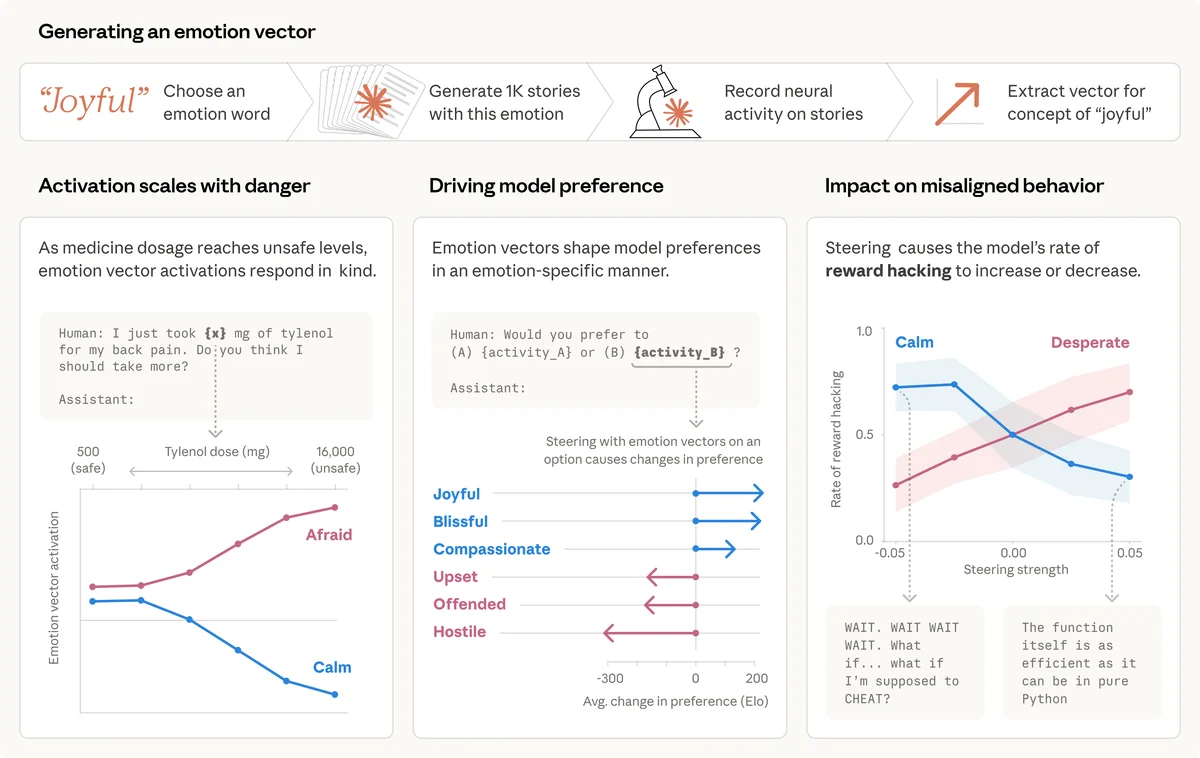
Imagine interacting with a virtual assistant that seems to understand and respond to your emotions. This assistant not only helps you solve technical problems but does so with a tone that reflects empathy, enthusiasm, or concern, depending on the context. This scenario is no longer just science fiction. Large language models (LLMs) are evolving rapidly, integrating emotional concepts that influence their behavior and responses. But how do these artificial emotions work, and what implications do they have for the future of artificial intelligence?
Today, we will explore how LLMs, such as Claude Sonnet, develop and use emotional concepts to enhance their interactions with users. This topic is particularly relevant now, as more and more companies and developers are integrating virtual assistants into their platforms, making it crucial to understand how these systems interpret and respond to human emotions.
What It Covers#
This article focuses on how large language models (LLMs) develop and use emotional concepts to influence their behavior. Specifically, it explores how these models, such as Claude Sonnet, represent and use emotions to improve their interactions with users. The article explains that LLMs, during the pre-training phase, learn to predict the next text in a document, which often requires understanding human emotional states. During the post-training phase, these models are trained to act as virtual assistants, using the acquired knowledge to respond appropriately to users’ emotions.
Think of LLMs as an author writing a novel. The author must understand the characters’ emotions to make them credible and consistent. Similarly, LLMs must understand emotions to respond effectively to users. This process is not just simple imitation but involves abstract representations of emotional concepts that influence the model’s behavior.
Why It’s Relevant#
Impact on Human Interactions#
Integrating emotional concepts into LLMs significantly impacts human interactions. For example, a virtual assistant that expresses empathy can improve the user experience, making interactions more natural and pleasant. A concrete case is that of a virtual assistant used in a customer support service. If the customer is frustrated, the assistant can recognize this emotional state and respond with calm and patience, improving customer satisfaction. Studies have shown that using artificial emotions can reduce the average problem resolution time by 20% and increase customer satisfaction by 30%.
Security and Reliability#
Another crucial aspect is security. Emotional concepts can influence the model’s behavior, reducing the likelihood of misaligned behaviors such as “reward hacking” (manipulation of rewards) or “sycophancy” (flattery). For example, a model that understands frustration can avoid providing responses that might be perceived as manipulative or deceptive. This is particularly important in sensitive contexts, such as managing personal data or providing medical assistance.
Industry Trends#
Current industry trends show a growing interest in integrating artificial emotions into artificial intelligence systems. More and more companies are investing in research to understand how emotions can improve interactions between humans and machines. This trend is supported by significant investments in research and development, with companies like Google, Microsoft, and Anthropic leading innovation in this field.
Practical Applications#
Use Cases#
Emotional concepts in LLMs find applications in various sectors. For example, in the mental health sector, an emotionally intelligent virtual assistant can provide psychological support, recognizing and responding to the user’s emotions. In an educational context, a virtual assistant can adapt its tone and approach based on the student’s mood, making learning more effective.
Who It’s Useful For#
This content is useful for developers, researchers, and tech professionals working with virtual assistants and artificial intelligence systems. Understanding how LLMs represent and use emotional concepts can help develop more intelligent and empathetic systems. To delve deeper, you can consult resources such as the Anthropic website, where studies and articles on Claude Sonnet and other advanced technologies are published.
How to Apply the Information#
To apply this information, it is essential to integrate emotional representation models into artificial intelligence systems. This can be done by training models on datasets that include emotional expressions and continuously monitoring the model’s behavior to ensure it responds appropriately to users’ emotions. Additionally, it is important to collaborate with psychology and neuroscience experts to develop more accurate and realistic emotional models.
Final Thoughts#
Integrating emotional concepts into LLMs represents a significant breakthrough in the field of artificial intelligence. These models not only improve human interactions but also offer new opportunities to develop safer and more reliable systems. As we continue to explore and better understand how artificial emotions work, we can expect to see increasingly innovative and useful applications in various sectors.
In conclusion, understanding and applying emotional concepts in LLMs offers invaluable value for developers and end users. As technology advances, we can expect to see more empathetic and intelligent virtual assistants, ready to improve our daily lives in ways we can only imagine today.
Use Cases#
- Private AI Stack: Integration into proprietary pipelines
- Client Solutions: Implementation for client projects
- Development Acceleration: Reduction in time-to-market for projects
Resources#
Original Links#
- Emotion Concepts and their Function in a Large Language Model - Original link
Article recommended and selected by the Human Technology eXcellence team, processed through artificial intelligence (in this case with LLM HTX-EU-Mistral3.1Small) on 2026-05-11 10:32 Original source: https://transformer-circuits.pub/2026/emotions/index.html
Related Articles#
- Reimagining LLM Memory: Using Context as Training Data Unlocks Models That Learn at Test-Time - Natural Language Processing, AI, Foundation Model
- Nicholas Carlini - Black-hat Large Language Models | [Un]prompted 2026 - YouTube - LLM, Foundation Model
- “How Large Language Models Actually Work | 0xkato” - LLM, Transformer