
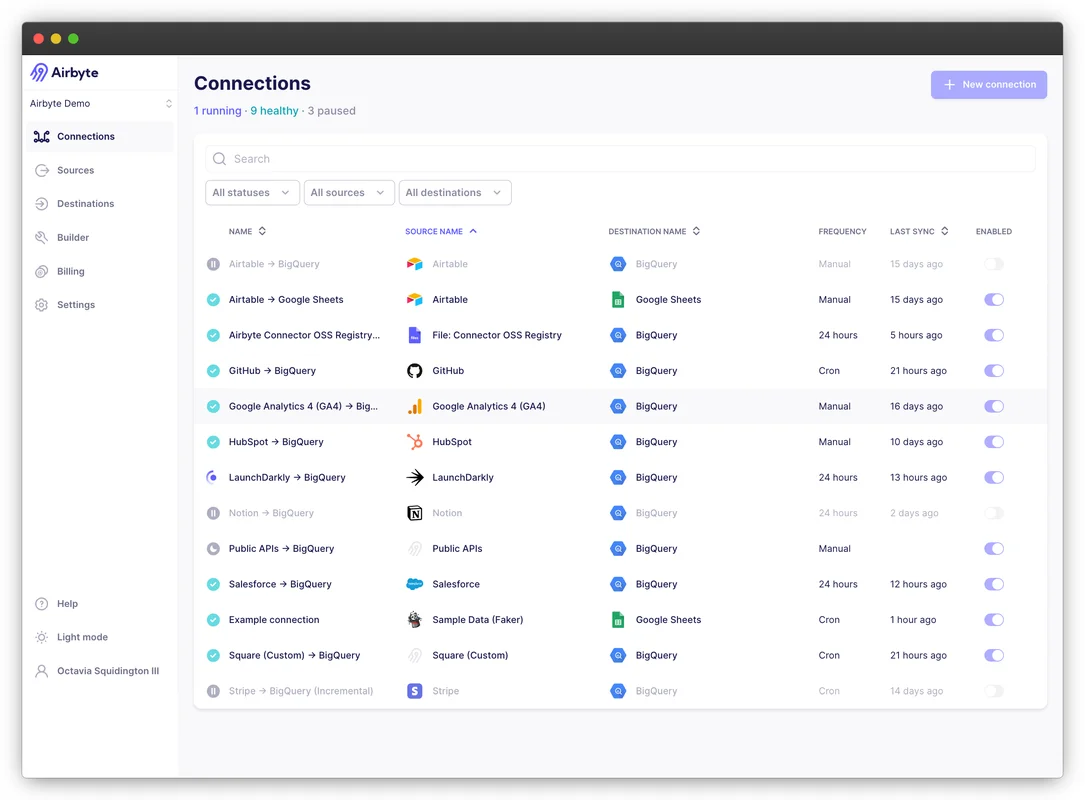
Type: GitHub Repository Original Link: https://github.com/airbytehq/airbyte?tab=readme-ov-file Publication Date: 2025-10-23
Summary#
WHAT - Airbyte is an open-source data integration platform for creating ETL/ELT pipelines from APIs, databases, and files to data warehouses, data lakes, and data lakehouses. It supports both self-hosted and cloud-hosted solutions.
WHY - It is relevant for AI business because it facilitates data integration and management, allowing for the centralization and synchronization of data from various sources efficiently. This is crucial for feeding machine learning models and advanced analytics.
WHO - The main players are AirbyteHQ, the open-source community, and the various users who contribute to the project. Competitors include Fivetran and Stitch.
WHERE - It positions itself in the data integration solutions market, targeting data engineers and companies that need to integrate data from different sources into a single environment.
WHEN - Airbyte is an established project with an active community and a significant user base. It is continuously evolving with regular updates and new features.
BUSINESS IMPACT:
- Opportunities: Integration with our existing stack to improve data management and feed AI models. Possibility of creating custom connectors for specific data sources.
- Risks: Competition with commercial solutions like Fivetran. Need to keep connectors updated to avoid obsolescence.
- Integration: Can be integrated with orchestration tools like Airflow, Prefect, and Dagster to automate data flows.
TECHNICAL SUMMARY:
- Core technology stack: Python, Java, support for various databases (MySQL, PostgreSQL, etc.), RESTful APIs.
- Scalability: Supports both self-hosted and cloud-hosted solutions, allowing for horizontal and vertical scalability.
- Limitations: Dependence on the community for maintaining and updating connectors.
- Technical differentiators: Open-source, flexibility in creating custom connectors, support for a wide range of data sources.
Use Cases#
- Private AI Stack: Integration in proprietary pipelines
- Client Solutions: Implementation for client projects
- Development Acceleration: Reduction in project time-to-market
- Strategic Intelligence: Input for technological roadmap
- Competitive Analysis: Monitoring AI ecosystem
Resources#
Original Links#
Article recommended and selected by the Human Technology eXcellence team, processed through artificial intelligence (in this case with LLM HTX-EU-Mistral3.1Small) on 2025-10-23 13:58 Original source: https://github.com/airbytehq/airbyte?tab=readme-ov-file
The HTX Take#
Infrastructure and compliance are the twin foundations of responsible AI adoption. This article highlights challenges that every European business faces when deploying AI — and the regulatory landscape is only getting stricter.
HTX’s answer is PRISMA — our Private Intelligence Stack for Modular AI. PRISMA provides the infrastructure layer that makes private AI practical: on-premise or EU cloud deployment, multi-model support, end-to-end encryption, and AI Act compliance built in from the ground up.
Whether you need a private chatbot (ORCA), natural language database access (MANTA), or clinical AI (KOI), PRISMA is the foundation that keeps your data sovereign and your operations compliant.
Ready to explore private AI for your business? Start with the free AI Readiness Assessment — 5 minutes to understand your opportunities.
Related Articles#
- Syllabi – Open-source agentic AI with tools, RAG, and multi-channel deploy - AI Agent, AI, DevOps
- Enterprise Deep Research - Python, Open Source
- SurfSense - Open Source, Python
FAQ
How can AI improve software development productivity in my company?
AI coding assistants can dramatically accelerate development — from code generation to testing to documentation. However, using cloud-based tools like GitHub Copilot means your proprietary code is processed externally. Private AI coding tools on your infrastructure keep your codebase secure while boosting developer productivity.
What are the security risks of AI-assisted coding?
Studies show AI-generated code has 1.7x more major issues and 2.74x higher security vulnerabilities. The solution isn't avoiding AI — it's pairing AI assistance with proper code review, security scanning, and private deployment to prevent IP leakage.