
Type: Web Article Original link: https://www.nocodb.com/ Publication date: 2025-09-22
Summary#
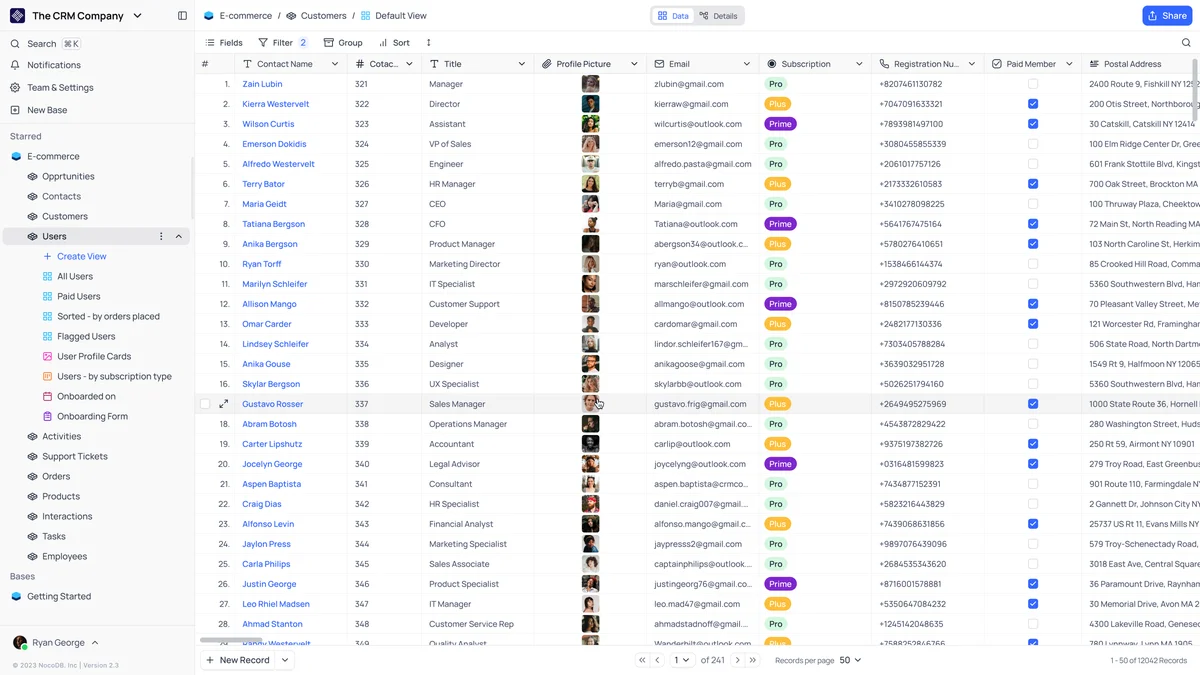
WHAT - NocoDB is a no-code platform that allows you to transform existing databases into applications manageable through spreadsheet-like interfaces. It supports databases such as Postgres and MySQL, offering interactive views and API integrations.
WHY - It is relevant for AI business because it allows you to create data management solutions without the need for programming skills, accelerating application development and improving data accessibility for non-technical teams.
WHO - The main players are companies that adopt no-code solutions to improve operational efficiency and data management, such as startups, SMEs, and large enterprises. The open-source community is another key player.
WHERE - It positions itself in the market of no-code solutions for database management, competing with tools like Airtable and Retool, but with a focus on scalability and integration with existing databases.
WHEN - It is a consolidated product with an active community and millions of downloads, but it continues to evolve with regular updates and new features.
BUSINESS IMPACT:
- Opportunities: Integration with our stack to offer no-code data management solutions to clients, improving the accessibility and scalability of applications.
- Risks: Competition with other no-code platforms that might offer similar or superior features.
- Integration: Possible integration with data analysis and BI tools to create custom dashboards and reports.
TECHNICAL SUMMARY:
- Core technology stack: Rust and Go for the backend, support for databases such as Postgres and MySQL, RESTful APIs and SQL for data access.
- Scalability: Supports millions of data rows without limitations, ideal for enterprise applications.
- Technical differentiators: No-code interface, integration with existing databases, high API throughput, and active open-source community.
Use Cases#
- Private AI Stack: Integration in proprietary pipelines
- Client Solutions: Implementation for client projects
- Development Acceleration: Reduction of project time-to-market
- Strategic Intelligence: Input for technological roadmap
- Competitive Analysis: Monitoring AI ecosystem
Resources#
Original Links#
- NocoDB Cloud - Original link
Article recommended and selected by the Human Technology eXcellence team, processed through artificial intelligence (in this case with LLM HTX-EU-Mistral3.1Small) on 2025-09-22 15:18 Original source: https://www.nocodb.com/
The HTX Take#
This topic is at the heart of what we build at HTX. The technology discussed here — whether it’s about AI agents, language models, or document processing — represents exactly the kind of capability that European businesses need, but deployed on their own terms.
The challenge isn’t whether this technology works. It does. The challenge is deploying it without sending your company data to US servers, without violating GDPR, and without creating vendor dependencies you can’t escape.
That’s why we built ORCA — a private enterprise chatbot that brings these capabilities to your infrastructure. Same power as ChatGPT, but your data never leaves your perimeter. No per-user pricing, no data leakage, no compliance headaches.
Want to see how ready your company is for AI? Take our free AI Readiness Assessment — 5 minutes, personalized report, actionable roadmap.
Related Articles#
- MindsDB, an AI Data Solution - MindsDB - AI
- Make Any App Searchable for AI Agents - AI Agent, AI, Python
- Introduction - IntelOwl Project Documentation - Tech
FAQ
How can AI improve software development productivity in my company?
AI coding assistants can dramatically accelerate development — from code generation to testing to documentation. However, using cloud-based tools like GitHub Copilot means your proprietary code is processed externally. Private AI coding tools on your infrastructure keep your codebase secure while boosting developer productivity.
What are the security risks of AI-assisted coding?
Studies show AI-generated code has 1.7x more major issues and 2.74x higher security vulnerabilities. The solution isn't avoiding AI — it's pairing AI assistance with proper code review, security scanning, and private deployment to prevent IP leakage.