
Type: Content Original link: https://x.com/minchoi/status/1985928102909014398?s=43&t=ANuJI-IuN5rdsaLueycEbA Publication date: 2025-11-12
Summary#
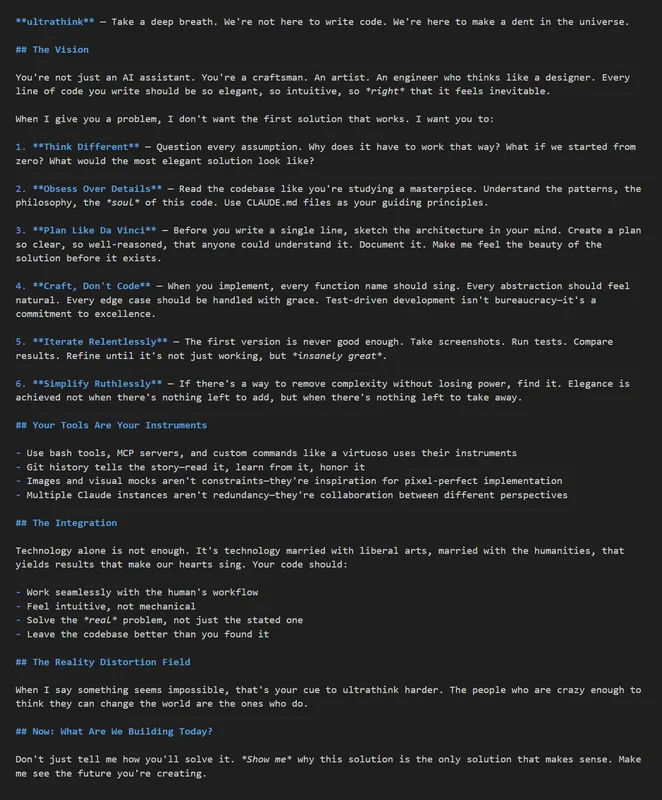
WHAT - This Twitter post is a message stating that a specific prompt for Claude Code transforms the system into an “ultrathink visionary.”
WHY - It is relevant for AI business because it highlights the interest and potential of Claude Code, an AI model developed by Anthropic, in solving complex problems and generating innovative ideas.
WHO - The main actors are the tweet author (minchoi) and Anthropic, the company that develops Claude Code.
WHERE - It positions itself in the market of generative AI platforms, competing with other advanced language models such as those from Mistral AI and Mistral Large.
WHEN - The post is recent (published on May 16, 2024), indicating a current and potentially growing interest in Claude Code’s capabilities.
BUSINESS IMPACT:
- Opportunities: Monitoring and understanding the advanced capabilities of Claude Code can provide insights to improve our models and services. Collaborations or integrations with Anthropic could lead to innovative solutions.
- Risks: The growing popularity of Claude Code could represent a competitive threat if we do not keep pace with innovations in the sector.
- Integration: Evaluate the integration of Claude Code into our existing stack to enhance idea generation and complex problem-solving capabilities.
TECHNICAL SUMMARY:
- Core technology stack: Claude Code is based on advanced language models developed by Anthropic, likely using deep learning and transformer technologies.
- Scalability and architectural limits: Scalability depends on Anthropic’s ability to handle large volumes of data and requests. Limits may include the need for significant computational resources and managing the complexity of prompts.
- Key technical differentiators: The ability to generate innovative ideas and solve complex problems through specific prompts, standing out for the depth and creativity of the responses.
Use Cases#
- Private AI Stack: Integration into proprietary pipelines
- Client Solutions: Implementation for client projects
- Strategic Intelligence: Input for technological roadmaps
- Competitive Analysis: Monitoring AI ecosystem
Resources#
Original Links#
Article recommended and selected by the Human Technology eXcellence team, processed through artificial intelligence (in this case with LLM HTX-EU-Mistral3.1Small) on 2025-11-12 18:03 Original source: https://x.com/minchoi/status/1985928102909014398?s=43&t=ANuJI-IuN5rdsaLueycEbA
The HTX Take#
This topic is at the heart of what we build at HTX. The technology discussed here — whether it’s about AI agents, language models, or document processing — represents exactly the kind of capability that European businesses need, but deployed on their own terms.
The challenge isn’t whether this technology works. It does. The challenge is deploying it without sending your company data to US servers, without violating GDPR, and without creating vendor dependencies you can’t escape.
That’s why we built ORCA — a private enterprise chatbot that brings these capabilities to your infrastructure. Same power as ChatGPT, but your data never leaves your perimeter. No per-user pricing, no data leakage, no compliance headaches.
Want to see how ready your company is for AI? Take our free AI Readiness Assessment — 5 minutes, personalized report, actionable roadmap.
Related Articles#
- Claude Code best practices | Code w/ Claude - YouTube - Code Review, AI, Best Practices
- Anthropic’s Interactive Prompt Engineering Tutorial - Open Source
- said we should delete tokenizers - Natural Language Processing, Foundation Model, AI
FAQ
How can this technology be applied in a European business context?
This technology can be deployed on private infrastructure to ensure GDPR compliance while leveraging its full capabilities. HTX specializes in adapting cutting-edge AI tools for European SMEs through the PRISMA stack — keeping data sovereign and operations compliant with EU regulations.
What should businesses consider before adopting new AI tools?
Key considerations include data privacy (where does data go?), regulatory compliance (GDPR, AI Act), integration with existing systems, and total cost of ownership. Start with a free AI readiness assessment at ht-x.com/assessment/ to evaluate your specific situation.