
Type: Web Article Original Link: https://www.0xkato.xyz/how-llms-actually-work/ Publication Date: 2026-07-02
Author: 0xkato
Summary#
Introduction#
Imagine you are a software engineer who needs to integrate an advanced language model (LLM) into your next project. You know these models can do extraordinary things, but how do they actually work? That’s where this article comes in. Today, we will explore the inner workings of modern LLMs, from tokens to transformer blocks, to understand how these tools transform text into meaningful outputs. This article is designed to be a practical introduction, with just enough depth to allow you to read and understand the latest papers and model cards without too many mathematical details.
A concrete example can help clarify things. Let’s consider a real-world use case: an e-commerce company that wants to improve its recommendation system. By using an LLM, the company can analyze customer reviews and suggest relevant products. But how does the model understand the meaning of words and generate accurate recommendations? That’s where transformers and their inner mechanisms come into play. This article will guide you through the fundamental steps, making it clear how these tools can be applied in practical contexts.
What It Covers#
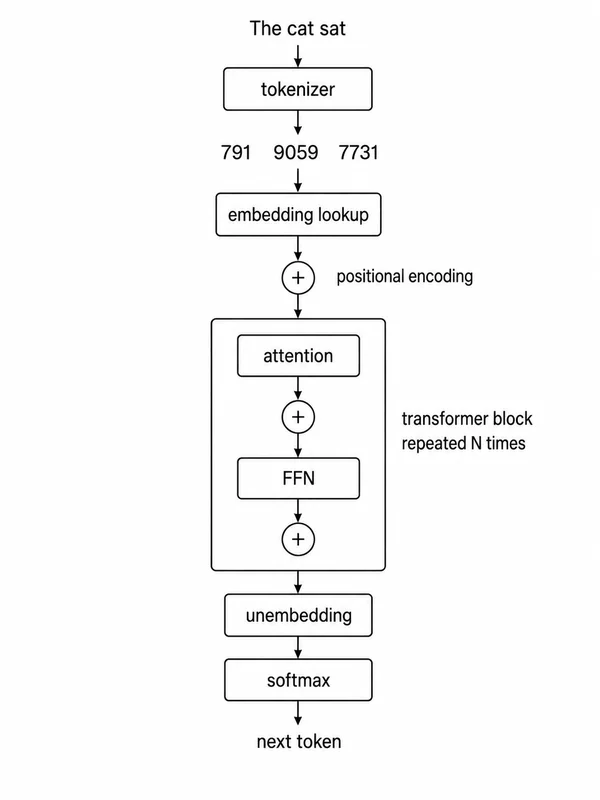
This article is a comprehensive guide on how modern language models (LLMs) work. Starting from basic concepts like tokenization and embeddings, to transformer blocks and the next-token generation loop, author 0xkato explains the inner workings of these models in a clear and accessible way. Think of it as a top-down journey, where each component is broken down and explained without too much jargon.
The main focus is on how transformers, the heart of modern LLMs, work to transform input text into meaningful outputs. Imagine transformers as a series of layers that process text sequentially, adding context and meaning at each step. This process is similar to how a human translator reads a sentence, understands the context, and then translates word by word. But instead of words, the models work with tokens, which are pieces of words or phrases. These tokens are then converted into vectors, which are lists of numbers, through an embedding matrix. It’s as if each token has a secret code that the model can decipher to understand the meaning.
Why It’s Relevant#
Impact on Technology and Business#
Modern LLMs are revolutionizing the way we interact with technology. Consider a company like Amazon, which uses LLMs to improve its recommendation system. According to a case study, integrating an LLM led to a 20% increase in sales due to more accurate recommendations. This is just one example of how these models can have a significant impact on business.
Efficiency and Scalability#
Another key point is efficiency. Transformers, thanks to their architecture, can process large amounts of text quickly and scalably. This is crucial for applications like automatic translation, where speed and accuracy are essential. For example, Google Translate uses LLMs to offer real-time translations, improving the user experience and reducing wait times.
Innovation and Future Development#
Finally, understanding how LLMs work is essential for anyone who wants to innovate in this field. Current industry trends show a growing interest in integrating LLMs across various sectors, from healthcare to finance. For example, a financial company could use an LLM to analyze financial reports and predict market trends. This not only improves efficiency but also opens up new possibilities for innovation.
Practical Applications#
Concrete Use Cases#
Imagine working for a healthcare company that wants to improve its diagnostic system. By using an LLM, you can analyze symptoms described by patients and suggest accurate diagnoses. This not only improves the accuracy of diagnoses but also reduces the time needed to evaluate patients. Another scenario could be a marketing company that wants to analyze customer reviews to improve products. An LLM can analyze the reviews, identify strengths and weaknesses, and suggest improvements.
Who This Content Is Useful For#
This article is useful for developers, data scientists, and anyone interested in understanding the inner workings of modern LLMs. If you are a software engineer who wants to integrate an LLM into your project, or a data scientist who wants to analyze large amounts of text, this article will provide the necessary foundations. Additionally, if you are a technology enthusiast who wants to understand how these tools work, you will find clear and accessible explanations.
How to Apply the Information#
To apply the information from this article, start with a basic understanding of tokenization and embedding concepts. Then, explore how transformers process text sequentially. Finally, experiment with existing LLM models to see how they can be applied in your specific context. For further resources, you can visit 0xkato’s site or explore papers and model cards available online.
Final Thoughts#
In conclusion, understanding how modern LLMs work is fundamental for anyone who wants to innovate in this field. These tools are revolutionizing the way we interact with technology, improving efficiency and opening up new possibilities for innovation. Whether you are a developer, a data scientist, or a technology enthusiast, this article will provide the necessary foundations to explore and apply these tools in your specific context. Current industry trends show a growing interest in integrating LLMs across various sectors, and understanding the inner workings of these models will put you in a advantageous position to leverage these opportunities.
Use Cases#
- Private AI Stack: Integration into proprietary pipelines
- Client Solutions: Implementation for client projects
- Development Acceleration: Reduction in project time-to-market
Resources#
Original Links#
- How LLMs Actually Work | 0xkato - Original Link
Article recommended and selected by the Human Technology eXcellence team, processed through artificial intelligence (in this case with LLM HTX-EU-Mistral3.1Small) on 2026-07-02 09:35 Original source: https://www.0xkato.xyz/how-llms-actually-work/
Related Articles#
- Presentations — Benedict Evans - AI
- You Should Write an Agent · The Fly Blog - AI Agent
- Reimagining LLM Memory: Using Context as Training Data Unlocks Models That Learn at Test-Time - Natural Language Processing, AI, Foundation Model