
Type: GitHub Repository Original Link: https://github.com/SalesforceAIResearch/enterprise-deep-research Publication Date: 2025-10-23
Summary#
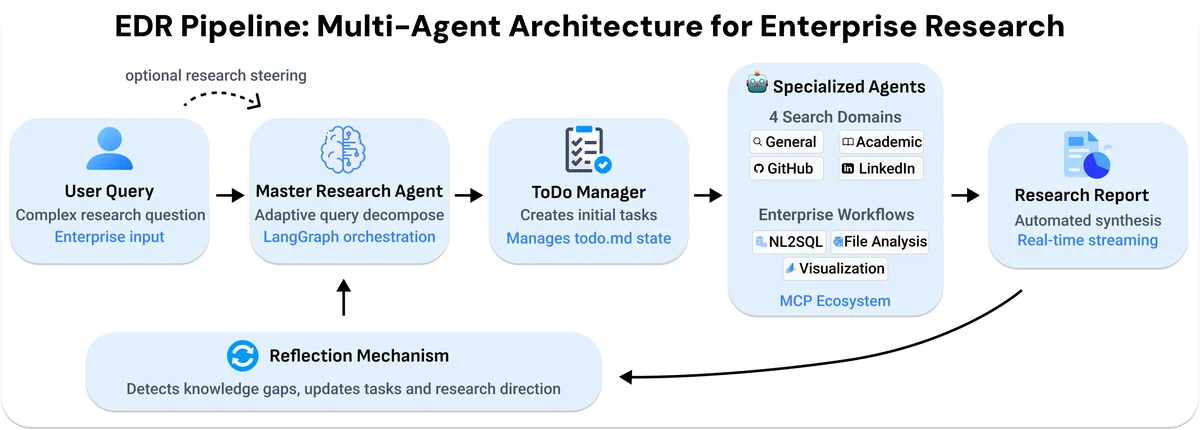
WHAT - Enterprise Deep Research (EDR) is a multi-agent system from Salesforce that integrates various specialized agents for in-depth business research. It includes a planning agent, specialized research agents, tools for data analysis and visualization, and reflection mechanisms for continuous updating of research.
WHY - EDR is relevant for business AI because it offers a comprehensive solution for automated research and analysis of business data, improving the efficiency and accuracy of research operations. It solves the problem of managing and integrating large volumes of data from different sources.
WHO - The main actors are Salesforce, which develops and maintains the project, and the open-source community that contributes to its development. Potential competitors include other business research platforms and artificial intelligence systems.
WHERE - EDR is positioned in the market of business research and data analysis solutions, integrating with the Salesforce AI ecosystem and other artificial intelligence platforms.
WHEN - EDR is a relatively new project, with a growing user base and an active community. The temporal trend indicates significant growth potential in the near future.
BUSINESS IMPACT:
- Opportunities: Integration with existing data analysis tools to improve business research and analysis. Possibility of customizing and extending the system to meet specific business needs.
- Risks: Competition with other business research solutions and the need to keep the system updated with the latest AI technologies.
- Integration: EDR can be integrated with the existing Salesforce stack and other artificial intelligence platforms, offering a comprehensive solution for research and data analysis.
TECHNICAL SUMMARY:
- Core technology stack: Python 3.11+, Node.js 20.9.0+, multi-agent framework, support for various LLM providers (OpenAI, Anthropic, Groq, Google Cloud, SambaNova).
- Scalability: The system is designed to be extensible and supports parallel processing and management of large volumes of data.
- Technical differentiators: Integration of specialized agents, reflection mechanisms for continuous updating of research, and support for real-time streaming and data visualization.
Use Cases#
- Private AI Stack: Integration in proprietary pipelines
- Client Solutions: Implementation for client projects
- Development Acceleration: Reduction of project time-to-market
- Strategic Intelligence: Input for technological roadmap
- Competitive Analysis: Monitoring AI ecosystem
Resources#
Original Links#
- Enterprise Deep Research - Original Link
Article recommended and selected by the Human Technology eXcellence team, elaborated through artificial intelligence (in this case with LLM HTX-EU-Mistral3.1Small) on 2025-10-23 13:55 Original Source: https://github.com/SalesforceAIResearch/enterprise-deep-research
The HTX Take#
This topic is at the heart of what we build at HTX. The technology discussed here — whether it’s about AI agents, language models, or document processing — represents exactly the kind of capability that European businesses need, but deployed on their own terms.
The challenge isn’t whether this technology works. It does. The challenge is deploying it without sending your company data to US servers, without violating GDPR, and without creating vendor dependencies you can’t escape.
That’s why we built ORCA — a private enterprise chatbot that brings these capabilities to your infrastructure. Same power as ChatGPT, but your data never leaves your perimeter. No per-user pricing, no data leakage, no compliance headaches.
Want to see how ready your company is for AI? Take our free AI Readiness Assessment — 5 minutes, personalized report, actionable roadmap.
Related Articles#
- Introducing Tongyi Deep Research - AI Agent, Python, Open Source
- paperetl - Open Source
- NeuTTS Air - Foundation Model, Python, AI
FAQ
Can open-source AI tools be used safely in enterprise?
Absolutely. Open-source models like LLaMA, Mistral, and DeepSeek are production-ready and used by major enterprises. The key is proper deployment: running them on your own infrastructure ensures data privacy and GDPR compliance. HTX's PRISMA stack is built to deploy open-source models for European businesses.
What's the advantage of open-source AI over proprietary solutions?
Open-source AI offers three key advantages: no vendor lock-in, full transparency into how the model works, and the ability to run entirely on your infrastructure. This means lower long-term costs, better privacy, and complete control over your AI stack.