
Type: Web Article Original link: https://www.nature.com/articles/s41586-025-09422-z Publication date: 2025-02-14
Summary#
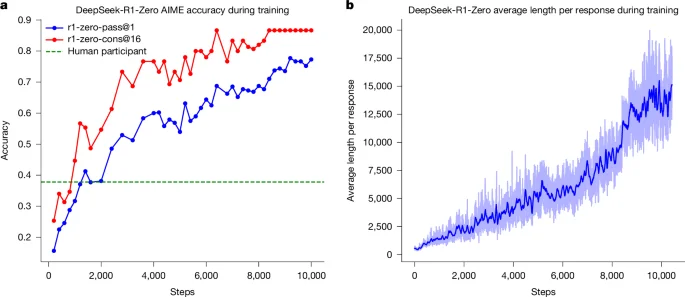
WHAT - The Nature article describes DeepSeek-R1, an AI model that uses reinforcement learning (RL) to enhance the reasoning capabilities of Large Language Models (LLMs). This approach eliminates the need for human-annotated demonstrations, allowing models to develop advanced reasoning patterns such as self-reflection and dynamic strategy adaptation.
WHY - It is relevant because it overcomes the limitations of traditional techniques based on human demonstrations, offering superior performance in verifiable tasks such as mathematics, programming, and STEM. This can lead to more autonomous and high-performing models.
WHO - Key players include the researchers who developed DeepSeek-R1 and the scientific community that studies and implements advanced AI models. The GitHub community is active in discussing and improving the model.
WHERE - It positions itself in the market of advanced AI, specifically in the sector of Large Language Models and reinforcement learning. It is part of the research and development ecosystem of artificial intelligence models.
WHEN - The article was published in February 2025, indicating that DeepSeek-R1 is a relatively new but already established model in academic research.
BUSINESS IMPACT:
- Opportunities: Integration of DeepSeek-R1 to enhance the reasoning capabilities of existing models, offering more autonomous and high-performing solutions.
- Risks: Competition with models using advanced RL techniques, potential need for investment in research and development to maintain competitiveness.
- Integration: Possible integration with the existing stack to improve the reasoning capabilities of corporate AI models.
TECHNICAL SUMMARY:
- Core technology stack: Python, Go, machine learning frameworks, neural networks, RL algorithms.
- Scalability: The model can be scaled to improve reasoning capabilities, but it requires significant computational resources.
- Technical differentiators: Use of Group Relative Policy Optimization (GRPO) and bypassing the supervised fine-tuning phase, allowing for more free and autonomous model exploration.
Use Cases#
- Private AI Stack: Integration into proprietary pipelines
- Client Solutions: Implementation for client projects
- Development Acceleration: Reduction in time-to-market for projects
Third-Party Feedback#
Community feedback: Users appreciate DeepSeek-R1 for its reasoning capabilities, but express concerns about issues such as repetition and readability. Some suggest using quantized versions to improve efficiency and propose integrating cold-start data to enhance performance.
Resources#
Original Links#
Article recommended and selected by the Human Technology eXcellence team, processed through artificial intelligence (in this case with LLM HTX-EU-Mistral3.1Small) on 2025-09-18 15:08 Original source: https://www.nature.com/articles/s41586-025-09422-z
The HTX Take#
This topic is at the heart of what we build at HTX. The technology discussed here — whether it’s about AI agents, language models, or document processing — represents exactly the kind of capability that European businesses need, but deployed on their own terms.
The challenge isn’t whether this technology works. It does. The challenge is deploying it without sending your company data to US servers, without violating GDPR, and without creating vendor dependencies you can’t escape.
That’s why we built ORCA — a private enterprise chatbot that brings these capabilities to your infrastructure. Same power as ChatGPT, but your data never leaves your perimeter. No per-user pricing, no data leakage, no compliance headaches.
Want to see how ready your company is for AI? Take our free AI Readiness Assessment — 5 minutes, personalized report, actionable roadmap.
Related Articles#
- [2511.10395] AgentEvolver: Towards Efficient Self-Evolving Agent System - AI Agent
- [2505.03335] Absolute Zero: Reinforced Self-play Reasoning with Zero Data - Tech
- [2505.24864] ProRL: Prolonged Reinforcement Learning Expands Reasoning Boundaries in Large Language Models - LLM, Foundation Model
FAQ
Can large language models run on private infrastructure?
Yes. Open-source models like LLaMA, Mistral, DeepSeek, and Qwen can run on-premise or on European cloud. These models achieve performance comparable to GPT-4 for most business tasks, with the advantage of complete data sovereignty. HTX's PRISMA stack is designed to deploy these models for European SMEs.
Which LLM is best for business use?
The best model depends on your use case. For document analysis and chat, models like Mistral and LLaMA excel. For data analysis, DeepSeek offers strong reasoning. HTX's approach is model-agnostic: ORCA supports multiple models so you can choose the best fit without vendor lock-in.