
Type: GitHub Repository Original Link: https://github.com/FareedKhan-dev/qwen3-MoE-from-scratch Publication Date: 2025-09-20
Summary#
WHAT - This is a tutorial that guides you through building a Qwen 3 MoE (Mixture-of-Experts) model from scratch, using Jupyter Notebook. The tutorial is based on a Medium article and includes a GitHub repository with code and additional resources.
WHY - It is relevant for AI business because it provides a practical guide to implementing an advanced LLM (Large Language Model) that can be used to enhance natural language processing capabilities. This can lead to more efficient and specialized solutions for AI applications.
WHO - The main actors include Fareed Khan, author of the tutorial, and Alibaba, which developed the Qwen 3 model. The primary audience is the community of AI developers and researchers.
WHERE - It positions itself in the AI educational market, offering resources for the development of advanced LLM models. It is part of the open-source tools ecosystem for AI.
WHEN - The tutorial was published in 2025, indicating that it is based on recent and advanced technologies. The maturity of the content is linked to the spread and adoption of the Qwen 3 model.
BUSINESS IMPACT:
- Opportunities: Implementing MoE models can improve the efficiency and specialization of AI solutions, offering a competitive advantage.
- Risks: Dependence on open-source technologies can involve risks related to code maintenance and updates.
- Integration: The tutorial can be used to train the internal development team, integrating the acquired knowledge into the existing technological stack.
TECHNICAL SUMMARY:
- Core technology stack: Jupyter Notebook, Python, PyTorch, Hugging Face Hub, sentencepiece, tiktoken, torch, matplotlib, tokenizers, safetensors.
- Scalability and architectural limits: The described model has 0.8 billion parameters, much fewer than the 235 billion of the original Qwen 3 model. This makes it more manageable but also less powerful.
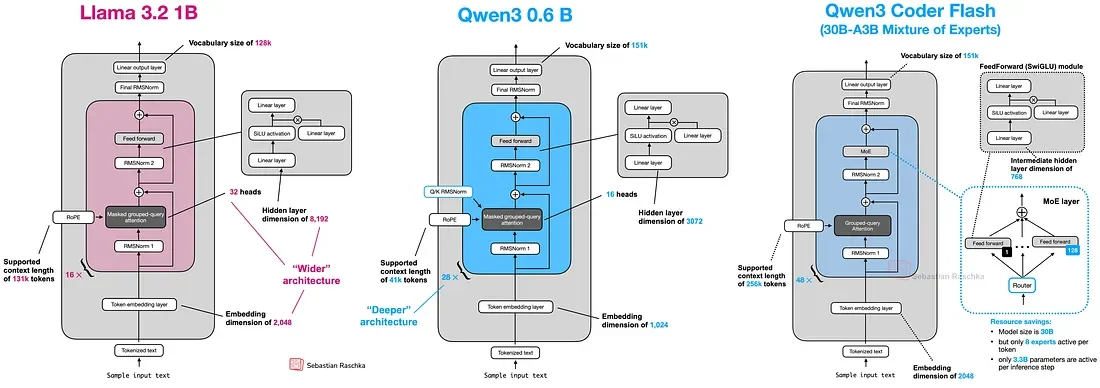
- Key technical differentiators: Use of Mixture-of-Experts (MoE) to activate only part of the parameters for queries, improving efficiency without sacrificing performance. Implementation of advanced techniques such as Grouped-Query Attention (GQA) and RoPE (Rotary Position Embedding).
Use Cases#
- Private AI Stack: Integration into proprietary pipelines
- Client Solutions: Implementation for client projects
- Development Acceleration: Reduction of project time-to-market
- Strategic Intelligence: Input for technological roadmap
- Competitive Analysis: Monitoring AI ecosystem
Resources#
Original Links#
Article recommended and selected by the Human Technology eXcellence team, processed through artificial intelligence (in this case with LLM HTX-EU-Mistral3.1Small) on 2025-09-23 16:51 Original source: https://github.com/FareedKhan-dev/qwen3-MoE-from-scratch
The HTX Take#
This topic is at the heart of what we build at HTX. The technology discussed here — whether it’s about AI agents, language models, or document processing — represents exactly the kind of capability that European businesses need, but deployed on their own terms.
The challenge isn’t whether this technology works. It does. The challenge is deploying it without sending your company data to US servers, without violating GDPR, and without creating vendor dependencies you can’t escape.
That’s why we built ORCA — a private enterprise chatbot that brings these capabilities to your infrastructure. Same power as ChatGPT, but your data never leaves your perimeter. No per-user pricing, no data leakage, no compliance headaches.
Want to see how ready your company is for AI? Take our free AI Readiness Assessment — 5 minutes, personalized report, actionable roadmap.
Related Articles#
- AI Hedge Fund - AI, Open Source
- Build a Large Language Model (From Scratch) - Foundation Model, LLM, Open Source
- AI Engineering Hub - Open Source, AI, LLM
FAQ
Can open-source AI tools be used safely in enterprise?
Absolutely. Open-source models like LLaMA, Mistral, and DeepSeek are production-ready and used by major enterprises. The key is proper deployment: running them on your own infrastructure ensures data privacy and GDPR compliance. HTX's PRISMA stack is built to deploy open-source models for European businesses.
What's the advantage of open-source AI over proprietary solutions?
Open-source AI offers three key advantages: no vendor lock-in, full transparency into how the model works, and the ability to run entirely on your infrastructure. This means lower long-term costs, better privacy, and complete control over your AI stack.