
Type: Web Article
Original Link: https://munderdiffl.in/
Publication Date: 2026-08-25
Summary#
Introduction#
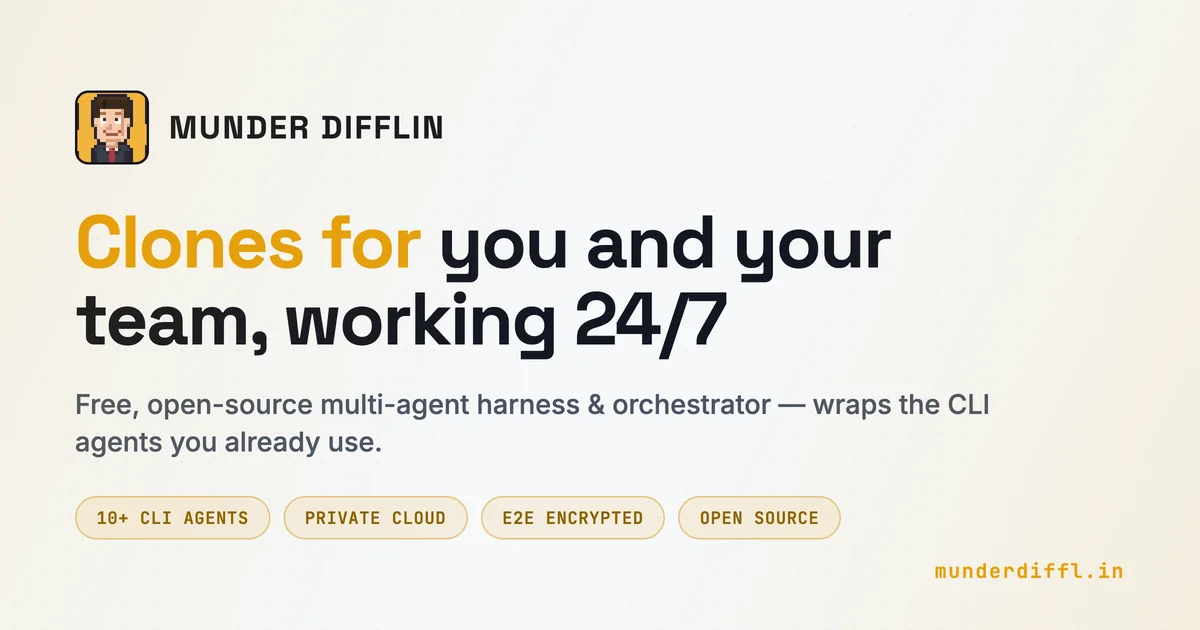
Imagine coming back from lunch and finding on your virtual desk a list of completed tasks: PRs reviewed according to your standards, bugs fixed, documentation updated, and even some client follow-ups already handled. It’s not science fiction, it’s what Munder Difflin promises to do. It’s an open source harness that transforms the CLI agents you already use — Claude Code, Copilot, Gemini and others — into a real office of clones working autonomously on your machine, 24/7. And the best part? It costs nothing to get started, works with your existing subscriptions, and everything stays under your control.
The project stems from a simple but powerful insight: AI agents are already capable of doing the work, but they work in silos. What would happen if they could coordinate, share context and pass work to each other like a real team would? Munder Difflin answers this question by creating an ecosystem where your clones not only work in parallel, but communicate, unblock each other and build a collective memory of your workflow.
What It Does#
Munder Difflin is a tool that embodies a revolutionary concept: instead of having a single shared bot for the team, each person gets a personal clone that knows their way of working, their standards, their preferred tools. This clone runs locally on your machine and can be trained on your specific workflow — how you review code, how you write documentation, what your nitpicks are in PRs.
But the real value emerges when clones start communicating with each other. If your clone needs design tokens to complete a task, it sends a message to your designer colleague’s clone, receives the response, and continues the work. Everything encrypted end-to-end, everything on your private network. It’s like having an office of versions of yourself working in parallel, coordinating autonomously and leaving you only the decisions that really matter.
Why It’s Relevant#
In an era where context-switching is the number one enemy of productivity, Munder Difflin addresses a concrete problem: your AI agents know how to do the work, but they don’t know how your team works. Every time you use them, you have to explain the context, the conventions, the preferences. With Munder Difflin, the clone learns once and remembers forever — and shares that memory with the other clones on the team.
Security is architected into the project’s DNA. Each clone runs on its owner’s laptop, API keys never leave the machine, and messages between clones are encrypted end-to-end. No one, not even the creators of Munder Difflin, can read what your clones are saying to each other. It’s open source (MIT license), so you can audit all the code. This is particularly important for teams working with sensitive data or with strict compliance constraints.
Integration is frictionless. You don’t have to change your tools. If you already use Claude Code, Copilot or Cursor, Munder Difflin simply wraps them and transforms them into always-on agents with memory and coordination. You bring your existing subscriptions, your API keys, your setup — nothing changes on your end, except that now you have a team of clones working for you.
Practical Applications#
Where Munder Difflin really shines is in the variety of roles that clones can play. A backend engineer clone can fix bugs and ship small features while you’re in a meeting. A designer clone can audit screens against the design system and export assets. A PM clone can triage issues, keep boards in sync and prepare summaries for standup. A sales person clone can prepare briefs for calls and follow up in the CRM.
For teams, the compounded value is even more interesting. Imagine a flow where a developer’s clone finishes a feature, passes it to the QA clone who tests it, which then passes it to the PM clone who updates the documentation — all without any human needing to manually coordinate. Clones escalate only the decisions that truly require human judgment. You come back from a meeting and find completed threads, not open questions.
For those who want to try it, the free and open source version is the perfect starting point. For teams that want dedicated cloud sandboxes and a centralized organizational knowledge base, there are paid plans that maintain the same security architecture but add scalability.
Final Thoughts#
Munder Difflin represents a paradigm shift in how we think about AI agents in teams. They’re not tools we use, they’re extensions of ourselves that learn our way of working and collaborate autonomously. At a time when technical talent scarcity is real and burnout is a constant threat, tools that multiply team capacity without requiring new hires have concrete value.
The fact that it’s open source, free for the core, and puts user security and control at the center of design makes it particularly interesting for teams that don’t want to depend on proprietary vendors. If you’re a developer, a designer, a PM or anyone working in a role where much of the work is scriptable, it’s worth taking a look. It might be time to stop working alone and start building your office of clones.
Use Cases#
- Technology Scouting: Evaluation of implementation opportunities
Resources#
Original Links#
- Munder Difflin — Agent harness to run an office of your clones - Original link
Article reported and selected by the Human Technology eXcellence team processed through artificial intelligence (in this case with LLM HTX-EU-Claude-Haiku-4.5) on 2026-08-25 07:44 Original source: https://munderdiffl.in/
Related Articles#
- Use Claude Code with Chrome (beta) - Claude Code Documentation - Browser Automation
- GitHub - block/buzz: A hive mind communication platform - Rust, Open Source, AI Agent
- GitHub - VibiumDev/vibium: Browser automation for AI agents and humans - Go, Browser Automation, AI