
Type: GitHub Repository
Original Link: https://github.com/deepseek-ai/DeepInfer
Publication Date: 2026-10-22
Summary#
Introduction#
Imagine having to serve thousands of simultaneous requests to a massive language model like DeepSeek-V4.1-Flash. We’re not talking about a chatbot that responds to a few users a day, but a production system that must handle real traffic, with predictable latencies and consistent throughput. The problem? Generic inference frameworks aren’t built for this. They waste precious time on scheduling overhead, don’t fully leverage available hardware, and struggle to maintain stable performance when load varies. DeepInfer is the answer that DeepSeek developed internally to tackle exactly this problem, and it’s now available as an open source project.
DeepInfer isn’t a lightweight wrapper around vLLM or TensorRT-LLM. It’s a completely optimized framework, built from the ground up to extract every drop of performance from modern hardware, whether it’s NVIDIA SM100 GPUs or Huawei Ascend NPUs. With nearly 20,000 stars on GitHub and an active community of contributors, it represents the state of the art in high-performance inference for large language models.
What It Does#
DeepInfer is essentially the engine that transforms a language model into a reliable and fast production service. It takes your DeepSeek model, loads it into memory, and prepares it to process thousands of tokens per second while maintaining low and predictable latencies.
The framework manages two critical phases of inference: prefill (when you process the initial prompt) and decode (when you generate response tokens one by one). Each of these phases has completely different dynamics, and DeepInfer optimizes them separately. During prefill, the system can massively parallelize work because all prompt tokens are available simultaneously. During decode, each token depends on the previous one, so optimization focuses on ultra-low latency and throughput per user.
What makes DeepInfer special is how it orchestrates all of this. It uses custom optimized kernels (FlashMLA, DeepGEMM, DeepEP), implements sophisticated parallelism with attention data parallelism and expert parallelism for MoE models, and introduces innovative techniques like DSpark (draft tokens with confidence-scheduled verification) to further accelerate decode. Everything is coordinated by a zero-overhead asynchronous scheduler that overlaps CPU work with GPU execution, eliminating traditional bottlenecks.
Why It’s Amazing#
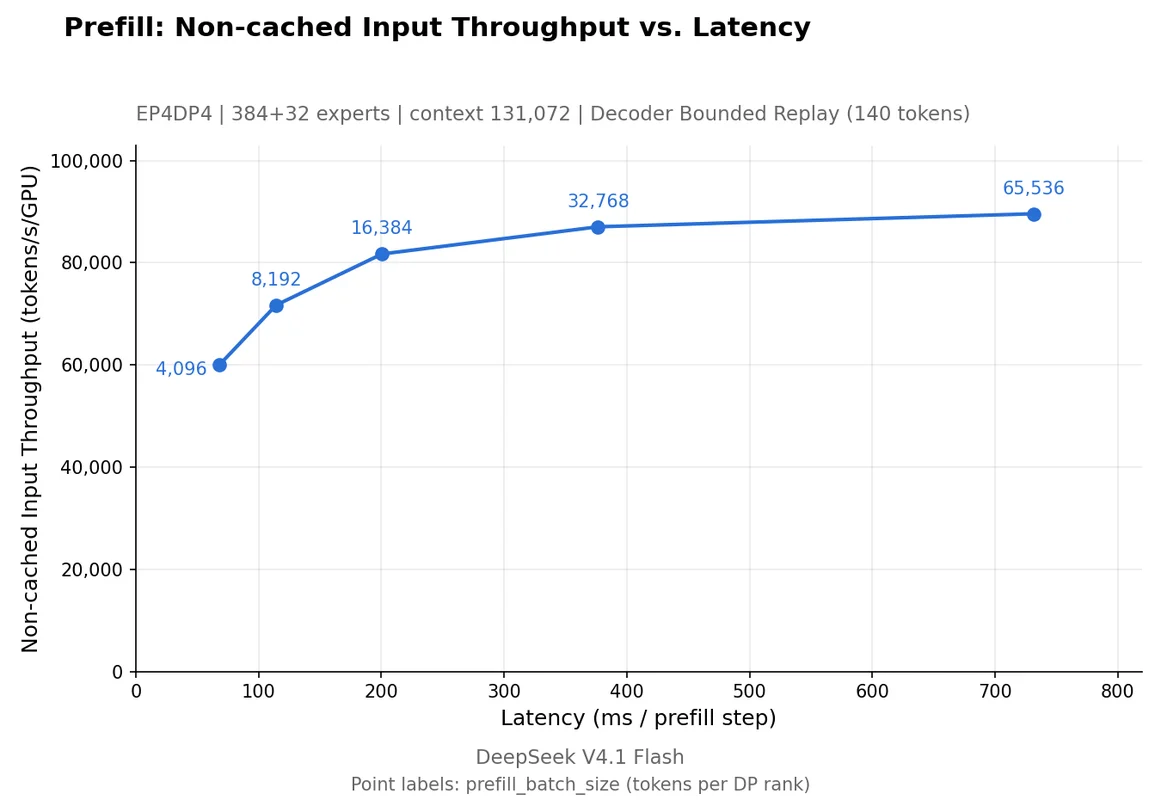
The “wow” factor of DeepInfer lies in the combination of raw performance and reliability. Benchmarks show impressive Pareto curves: you can choose whether to prioritize maximum throughput during prefill or minimum latency for decode, and the framework lets you navigate this trade-off granularly. But it’s not just raw speed.
Determinism and reproducibility: A feature often undervalued but critical in production. DeepInfer can guarantee that identical inputs and sampling parameters produce identical outputs, regardless of batch composition. This is fundamental for debugging, testing, and compliance. You simply enable DEEPINFER_BATCH_INVARIANT=1 and the system maintains consistency even as load varies.
Intelligent decoding with DSpark: Instead of generating each token sequentially (slow), DeepInfer generates “draft” tokens in parallel and then verifies if they’re correct using confidence estimates. If confidence is high, the token is accepted directly. If it’s low, it’s rejected and regenerated. This drastically reduces the number of forward passes needed, accelerating decode by a significant factor without compromising quality.
Structured outputs: You can constrain generation to regex, JSON schema, or EBNF grammars. This means the model will never generate malformed output. If you ask for JSON, you get valid JSON. If you ask for a number between 1 and 100, the model will never generate 150. It’s a feature that greatly simplifies integration into complex pipelines.
Sophisticated parallelism: DeepInfer implements attention data parallelism, expert parallelism for MoE models, and balanced context parallelism. It’s not a simple “divide the batch between GPUs.” It’s intelligent orchestration that understands model structure and distributes load optimally. On 64 GPUs for decode, this translates to per-user throughput that remains stable even with thousands of simultaneous requests.
Asynchronous scheduling: Traditionally, the CPU prepares the batch, sends it to the GPU, waits for it to finish, then prepares the next batch. DeepInfer overlaps these operations. While the GPU processes the current batch, the CPU already prepares the next one. This eliminates idle gaps and reduces end-to-end latency.
How to Try It#
DeepInfer is available on GitHub at github.com/deepseek-ai/DeepInfer. Setup requires a Linux environment with Python 3.12, GCC >= 13.0, and CUDA 13 (for NVIDIA) or CANN 9.2 (for Ascend). It’s not a one-click demo, but the process is reasonably straightforward.
After cloning the repository, you create an empty Python 3.12 environment, export the DEEPINFER_ACCELERATOR=nvidia variable (or ascend if you use Huawei), and run ./build.sh. The system will automatically download the DeepSeek-V4.1-Flash checkpoint from Hugging Face on first run, or you can point to a local copy via DEEPINFER_HF_MODEL_DIR. The documentation in the repository includes offline inference examples and scripts to reproduce official benchmarks on 4 GPUs for prefill and 64 for decode.
For those wanting to dive deeper, the repository also contains evaluation code and detailed documentation on how to configure various features (DSpark, batch-invariant inference, structured outputs). The community is active in answering questions, and the code is well-structured for those wanting to contribute or extend the framework.
Final Thoughts#
DeepInfer represents an important moment in the evolution of the open source ecosystem for AI. It’s not just a tool, it’s the materialization of years of research and optimization by DeepSeek, made available to the community. At a time when language models are becoming increasingly large and inference requests increasingly complex, having access to a framework built for real production is valuable.
What makes this project particularly interesting is that it’s not a simplification. DeepInfer maintains the complexity necessary to achieve real performance, but exposes it through reasonable APIs. If you’re a developer wanting to serve DeepSeek models in production, or a researcher interested in optimization techniques for inference, DeepInfer deserves to be in your toolkit.
Use Cases#
- Private AI Stack: Integration into proprietary pipelines
- Client Solutions: Implementation for client projects
- Development Acceleration: Reduction of project time-to-market
Resources#
Original Links#
Article reported and selected by the Human Technology eXcellence team processed through artificial intelligence (in this case with LLM HTX-EU-Claude-Haiku-4.5) on 2026-10-22 13:13 Original source: https://github.com/deepseek-ai/DeepInfer
Related Articles#
- Why your local LLM feels dumber than it is - LLM, Natural Language Processing, Transformer
- GitHub - alexziskind1/llama-throughput-lab: Interactive launcher and benchmarking framework for llama.cpp server throughput, featuring tests, sweeps, and round-robin load tools. - Open Source, Python
- GitHub - chiennv2000/orthrus: Fast, lossless LLM inference via dual-view diffusion… - Python, LLM, Open Source