
- HTX | Private AI for European Enterprises — ORCA · MANTA · KOI · TIDE/
- KOI — AI for Anesthesia | ASA-PS Classification -89% Error | HTX/
KOI — AI for Anesthesia | ASA-PS Classification -89% Error | HTX
AI for anesthesia.
Automatic ASA-PS classification with advanced reasoning models. -89% classification error compared to physicians. Clinical data that never leaves your hospital.
error reduction
accuracy
on-premise
Finalist at the Ramsay Santé Innovation Awards 2026.
The AI-enhanced preoperative risk assessment project of the Centro Ortopedico di Quadrante (Ramsay Santé), developed with HTX and built on KOI, is one of the 6 finalists out of 122 projects submitted to the Ramsay Santé Innovation Awards 2026, in the Best Impact for Our Patients category.
A recognition of the work done together with anaesthesiologists and orthopaedic surgeons: bringing AI into preoperative risk assessment, with the physician always at the centre of the decision.
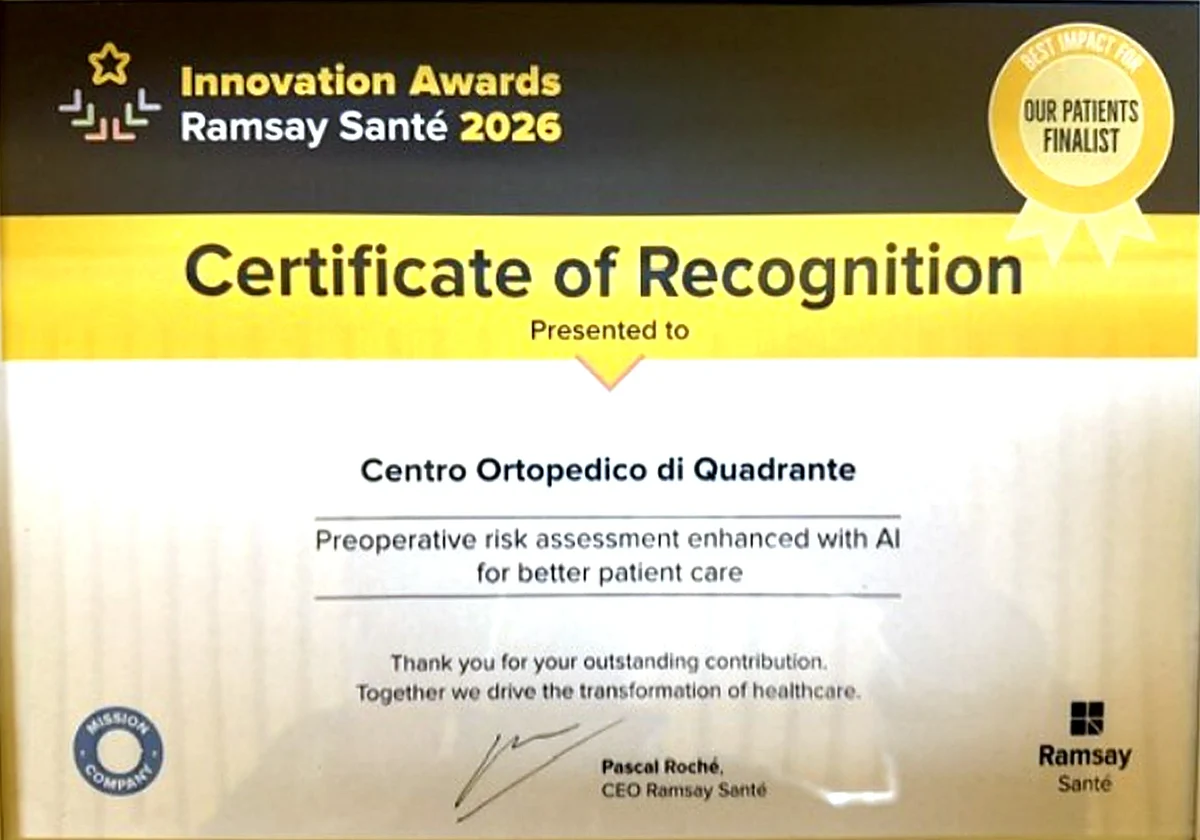
 Centro Ortopedico di Quadrante
Ramsay Santé Group
Decision support for the anesthesiologist.
ASA-PS classification is the standard for preoperative anesthetic risk assessment. But inter-rater variability is high: physicians agree on the correct classification in only 7 out of 10 cases. KOI reduces this variability with advanced reasoning AI.
Patient record analysis
KOI receives patient data: medical history, physical examination, diagnostic tests. The AI model analyzes the complete clinical picture.
Chain-of-thoughtASA-PS classification
The model produces an ASA-PS classification with detailed clinical reasoning and confidence score. Every decision is explainable and verifiable.
97.5% accuracyPhysician decision
The anesthesiologist reviews the proposed classification, compares it with their own clinical judgment, and decides. KOI supports, never replaces.
Human-in-the-loopValidated on 28 standardized clinical cases plus a 150-case benchmark.
The HTX study evaluated 11 language models — from early-generation models (GPT-4, LLaMA) to advanced reasoning models (GPT-o3, Claude Sonnet, DeepSeek R1) — on 28 standardized clinical cases from the most studied ASA-PS benchmarks in the literature, plus a 150-vignette distributional benchmark.
Key findings: advanced models achieve 97.5% accuracy (117/120; 95% CI: 95.0%-100.0%), significantly outperforming both early-generation models (77%) and the human benchmark (7.7/10). Mean error drops from 2.3 to 0.25 misclassifications per 10 cases. DeepSeek R1, deployable on-premise, reached 100% (8/8) on independent held-out cases with perfect reproducibility — and on the 150-case benchmark its ASA-PS distribution did not differ from the expert panel's.
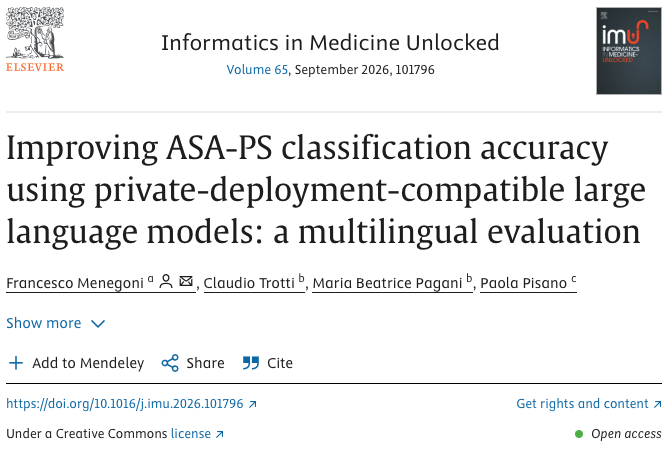
The study is published open access in Informatics in Medicine Unlocked (Elsevier, vol. 65, 2026, 101796): Improving ASA-PS classification accuracy using private-deployment-compatible large language models: a multilingual evaluation.

Clinical data never leaves the hospital.
KOI runs on PRISMA, HTX's private AI infrastructure. On-premise or European cloud deployment, with end-to-end encryption. No patient data is sent to external servers.
38.4% of healthcare LLM studies fail to implement adequate data protections. KOI is designed for GDPR and AI Act compliance by design — because in healthcare, privacy is not optional.
Funded research project
KOI was born from the "ASA-PS Classification" project, funded by the Friuli Venezia Giulia Region (LR 22/2022, art. 7 — TRL 6-8 validation support, EUR 90k grant). In collaboration with Ospedale del Quadrante (Ramsay Sante), the project clinically validates the AI system for ASA-PS classification. Period: December 2025 - November 2026. Currently Research Use Only (RUO) — medical device clearance planned for 2027.
KOI FAQ
What is KOI and how does it work?
KOI automatically classifies patients according to the ASA-PS scale for anesthesiology — 89% fewer errors than manual classification. It uses advanced reasoning models that analyze the patient record and produce a classification with detailed clinical explanation.
Can I deploy KOI in my hospital?
Yes. KOI runs on PRISMA, deployable on-premise. Clinical data never leaves the facility. Full GDPR and AI Act compliance.
Is KOI a medical device?
KOI is currently classified as Research Use Only (RUO) — available for research and clinical validation, not for diagnostic practice. HTX is pursuing ISO 13485 and IEC 62304 certification, with medical device clearance planned for 2027. KOI is developed with Ospedale del Quadrante (Ramsay Sante), supported by a EUR 90,000 grant from the FVG Region.