
Type: Web Article
Original Link: https://forum.level1techs.com/t/why-your-local-llm-feels-dumber-than-it-is/253917
Publication Date: 2026-08-25
Summary#
Introduction#
How many times have you downloaded a language model that everyone was raving about on forums, Reddit, or Discord, only to be disappointed by the results? “This model is amazing!” they say. You download it (or more likely a quantized version), run it on your machine, and think: “What a letdown”. The reality is that the problem might not be the model itself, but how you’re running it. When you read that a model is “AMAZEBALLZ”, the researchers who created it were testing it on specific hardware, with specific software and precise configurations. Your setup? It’s completely different. And this difference has a real and measurable impact on the quality of the output you receive.
This article addresses an uncomfortable truth in the world of local LLMs: the gap between promised and actual performance isn’t always the model’s fault. It’s a matter of implementation, configuration, and how software and hardware interact in your specific environment.
What It Covers#
The original article is an in-depth technical analysis of how implementation choices influence the actual performance of LLMs when you run them locally. The main focus is explaining why your local model produces different results compared to benchmarks published by the model creators.
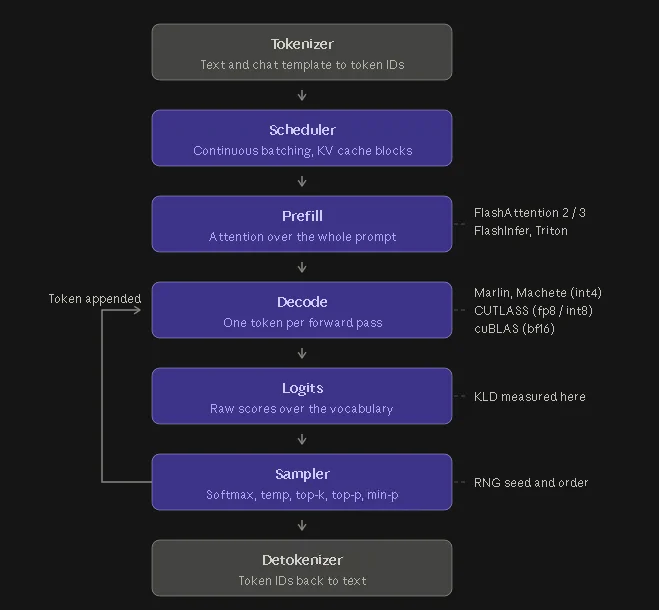
The key lies in “logits” – the scores the model assigns to each possible next token. These are converted into probabilities, passed through a sampler, and transformed into text. Even small variations in this process can lead to significantly different outputs. Imagine following a road: a small detour at the beginning can take you to a completely different city. The same happens with tokens: a slightly altered probability for the first token can put the model on a completely different path.
The article also explores how to measure these divergences using metrics like KL Divergence (KLD), which measures how much the probability distribution of your output deviates from a reference baseline. But here’s the trick: a low KLD number doesn’t automatically mean “smarter”, and many people misinterpret these numbers because they don’t understand the underlying methodology.
Why It Matters#
If you’re running LLMs locally, this is critical information. Configuration is everything: every hardware setup is slightly different (or very different). If you’re using GPUs from different generations, they have different instruction sets that execute mathematical operations slightly differently. If you’re using vLLM, Ollama, or other inference frameworks, each one has hundreds of software dependencies, each with its own undocumented bugs and behaviors.
The quantization problem: when you download a quantized version of a model (which reduces numerical precision to save memory), you’re already introducing divergences from the original model. If you then add wrong sampler configurations – and many people do – the divergence increases further.
Settings really matter: an apparently trivial detail like the temperature of the sampler can make the difference between coherent output and a model stuck in loops. If your Qwen seems unable to escape repetitive outputs, you’re probably using a temperature that’s too low. This isn’t a model problem; it’s a configuration problem.
The practical relevance is immediate: when you read a benchmark saying “model XYZ achieves 92% on MMLU”, you need to understand that number was obtained under very specific conditions. Your result will be different, and it’s not necessarily because the model is “dumb” – it’s because your execution environment is different.
Practical Applications#
If you’re building a home lab with local LLMs, the first thing to do is run benchmarks representative of your actual use case, not just zero-shot tests with sample prompts. If your use case involves tool-calling, long context, and reasoning on specific domains, you need to test exactly that. Don’t set temperature to zero and declare the model “good” or “bad” based on a few test prompts.
Check the model settings: most models on Hugging Face specify exactly which sampler to use (temperature, top-p, etc.) and which chat template to apply. If you’re not using these settings, you’re already starting at a disadvantage. It’s like driving a sports car with the wrong gears.
Understand your software stack: if you’re using vLLM, Ollama, or other frameworks, know that every component in your inference stack can introduce divergences. It’s not paranoia – it’s technical reality. When choosing a framework, consider not just performance, but also stability and documentation of its implementation choices.
For those who want to dive deeper, the Level1Techs forum (linked in the original article) contains detailed discussions on how to measure and optimize these divergences in your specific setup.
Final Thoughts#
The central message is liberating: if your local LLM isn’t reaching published benchmarks, it’s not necessarily because the model is inferior. It’s probably because you’re running it differently than how it was originally tested. This is good news, because it means you have room for improvement through optimization and configuration.
In the landscape of local LLMs, awareness of these implementation divergences has become crucial. As more people run models locally – for privacy, latency, or cost reasons – understanding these technical details makes the difference between a frustrating experience and an optimized setup. The next time you download an “amazing” model, remember: the model might really be good. The problem might simply be how you’re running it.
Use Cases#
- Private AI Stack: Integration into proprietary pipelines
- Client Solutions: Implementation for client projects
Resources#
Original Links#
- Why your local LLM feels dumber than it is - Original link
Article reported and selected by the Human Technology eXcellence team processed through artificial intelligence (in this case with LLM HTX-EU-Claude-Haiku-4.5) on 2026-08-25 17:34 Original source: https://forum.level1techs.com/t/why-your-local-llm-feels-dumber-than-it-is/253917
Related Articles#
- spent the entire day testing Qwopus (Claude 4) - Tech
- Nativ — Run AI locally on your Mac - Foundation Model, LLM, Computer Vision
- Everyone is building LLM routers, we deprecated ours. - LLM, Natural Language Processing, Model Routing