
Type: Web Article
Original Link: https://sebastianraschka.com/blog/2026/kimi-k3-architecture-notes.html
Publication Date: 2026-08-18
Author: Sebastian Raschka
Summary#
Introduction#
Imagine having to build an artificial intelligence model that’s as powerful as the world’s best, but consumes significantly less energy during inference. It sounds like an almost impossible challenge, yet that’s exactly what the team behind Kimi K3 has achieved. Sebastian Raschka, one of the leading experts in AI architectures, recently analyzed the technical details of this new Chinese open-weight model, and what emerges is fascinating: it’s not just a larger model, but an intelligent redesign of how the fundamental components of modern LLMs should work. At a time when computational efficiency is becoming crucial for democratizing access to AI, this architecture represents an important turning point in the industry.
What It’s About#
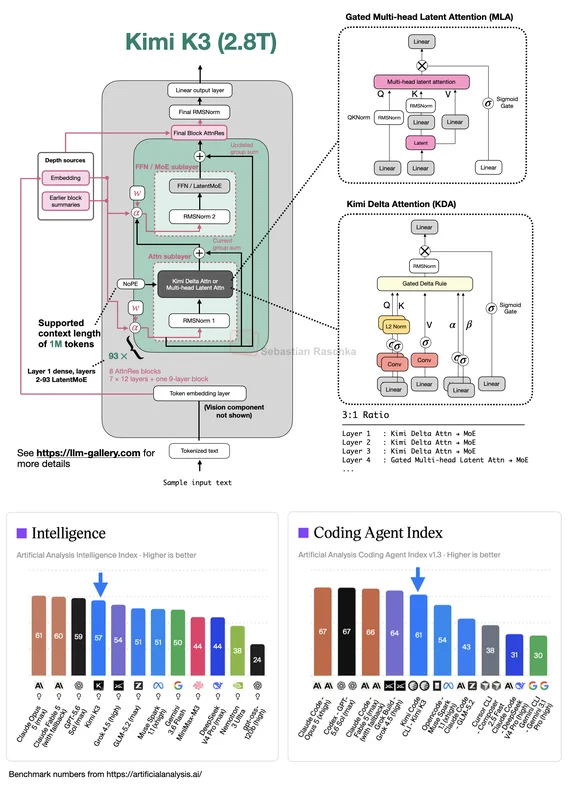
Kimi K3 is essentially a production-scale version of the previous Kimi Linear model, but with significant innovations specifically designed to reduce computational costs without sacrificing performance. The heart of Raschka’s analysis revolves around how this model systematically replaces traditional components with efficiency-optimized versions. Where other models use standard Mixture of Experts (MoE), Kimi K3 employs LatentMoE, a technique that compresses large linear layers just as latent multi-head attention would. Similarly, traditional attention is replaced with more efficient versions like Kimi Delta Attention. It’s as if the team went through every component of the architecture and asked: “How can we do the same thing with fewer resources?”
A particularly interesting element is the complete abandonment of RoPE (Rotary Position Embeddings) in favor of NoPE (No Positional Embeddings) across all layers. While other recent architectures maintain RoPE in local attention layers, Kimi K3 is the first frontier-level model to use NoPE exclusively everywhere, a bold choice that appears to pay off in terms of efficiency.
Why It Matters#
The importance of Kimi K3 goes beyond simple technical numbers. First, it represents a systematic efficiency strategy: it’s not a single brilliant optimization, but a coherent approach where every component has been rethought. This means improvements compound, creating a model that maintains competitive performance while requiring significantly fewer computational resources during inference. For those developing AI applications in production, this translates to lower costs and reduced latency.
Second, the addition of native multimodal support transforms Kimi K3 from a purely textual model to a system capable of processing images and text together. This aligns the model with modern user expectations and opens new use cases, from website generation (as highlighted by the community) to analysis of complex documents.
Finally, there’s a broader dimension: Kimi K3 demonstrates that significant architectural innovation is not a monopoly of American labs. Chinese research is producing competitive results with different approaches, forcing the entire industry to rethink basic assumptions about how to build efficient models. This is particularly relevant given community concerns about AI commoditization strategy: efficient open-weight models lower barriers to entry for developers and organizations worldwide.
Practical Applications#
If you’re a developer working with LLMs in production, Kimi K3 offers concrete lessons. LatentMoE and Delta Attention techniques could inspire optimizations in your models, especially if you’re looking to reduce inference costs. If you work on multimodal applications, native support for images and text opens new possibilities without having to manage separate pipelines.
For researchers, the architecture is a fascinating case study on how to rethink fundamental components. The use of attention residuals to improve residual paths, for example, represents an interesting alternative to approaches like DeepSeek V4’s mHC (manifold-constrained Hyper-Connections). For those studying computational efficiency, the complete abandonment of RoPE in favor of NoPE is an experiment worth attention.
You can find complete technical details in Raschka’s blog and in the LLM architecture gallery, where tutorials and in-depth information on each component are available.
Final Thoughts#
Kimi K3 represents a moment of maturity in the AI ecosystem: it’s no longer enough to build large models, you have to build them intelligently. The trend toward efficiency we see in Kimi K3, DeepSeek V4, and Nemotron Ultra suggests that the next chapter of AI won’t be dominated by those with the most powerful servers, but by those who know how to optimize better. This is potentially democratizing, allowing teams and organizations with limited resources to compete. At the same time, it raises important questions about AI geopolitics and how global research is converging toward similar solutions. For anyone working in the field, following these architectural evolutions is no longer optional: it’s the way to stay relevant in a rapidly changing landscape.
Use Cases#
- Private AI Stack: Integration into proprietary pipelines
- Client Solutions: Implementation for client projects
Third-Party Feedback#
Community feedback: The discussion highlights impressiveness with Kimi K3’s generative capabilities (particularly in website generation), but concerns emerge about Chinese commercial strategy to commoditize AI and the potential technology gap with US labs.
Resources#
Original Links#
- Kimi K3 Architecture Notes - Original link
Article reported and selected by the Human Technology eXcellence team processed through artificial intelligence (in this case with LLM HTX-EU-Claude-Haiku-4.5) on 2026-08-18 08:13 Original source: https://sebastianraschka.com/blog/2026/kimi-k3-architecture-notes.html
Related Articles#
- Reimagining LLM Memory: Using Context as Training Data Unlocks Models That Learn at Test-Time - Natural Language Processing, AI, Foundation Model
- Conditional Memory via Scalable Lookup: A New Dimension of Sparsity for Large Language Models - Foundation Model, LLM
- Everyone is building LLM routers, we deprecated ours. - LLM, Natural Language Processing, Model Routing