
Type: Web Article Original link: https://www.nature.com/articles/s41586-025-09215-4 Publication date: 2024-10-26
Summary#
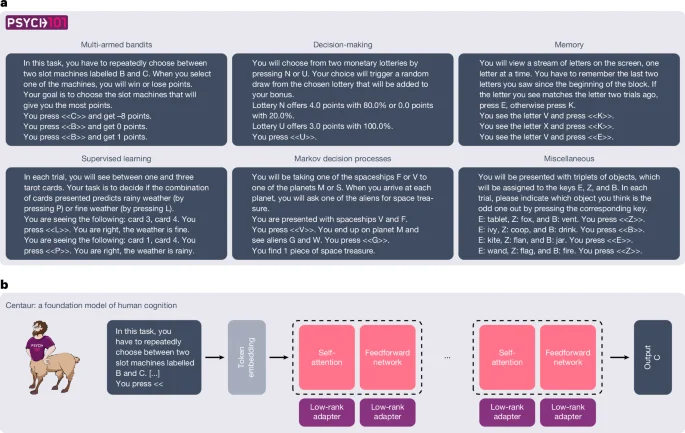
WHAT - The Nature article presents Centaur, a computational model that predicts and simulates human behavior in experiments expressible in natural language. Centaur was developed by fine-tuning an advanced language model on a large dataset called Psych-101.
WHY - It is relevant for the AI business because it demonstrates the possibility of creating models that capture human behavior in various contexts, driving the development of cognitive theories and potentially improving human-machine interactions.
WHO - The authors of the article, published in Nature, are the main actors. No details are provided about the company or community behind Centaur.
WHERE - It positions itself in the market of cognitive research and AI, offering a unified approach to understanding human behavior.
WHEN - The article was published on October 26, 2024, indicating a recent advancement in the field of cognitive modeling.
BUSINESS IMPACT:
- Opportunities: Developing more intuitive and adaptable AI models, improving human-machine interaction applications.
- Risks: Competition from other companies adopting similar models to enhance their AI solutions.
- Integration: Possible integration with existing artificial intelligence systems to improve the understanding of human behavior.
TECHNICAL SUMMARY:
- Core technology stack: Natural language, advanced language models, large datasets (Psych-101).
- Scalability: The model demonstrates the ability to generalize to new domains and unseen situations.
- Technical differentiators: Alignment of the model’s internal representations with human neural activity, improving the accuracy of behavioral predictions.
Use Cases#
- Private AI Stack: Integration into proprietary pipelines
- Client Solutions: Implementation for client projects
- Strategic Intelligence: Input for technological roadmaps
- Competitive Analysis: Monitoring AI ecosystem
Resources#
Original Links#
Article recommended and selected by the Human Technology eXcellence team, processed through artificial intelligence (in this case with LLM HTX-EU-Mistral3.1Small) on 2025-09-06 10:28 Original source: https://www.nature.com/articles/s41586-025-09215-4
The HTX Take#
This topic is at the heart of what we build at HTX. The technology discussed here — whether it’s about AI agents, language models, or document processing — represents exactly the kind of capability that European businesses need, but deployed on their own terms.
The challenge isn’t whether this technology works. It does. The challenge is deploying it without sending your company data to US servers, without violating GDPR, and without creating vendor dependencies you can’t escape.
That’s why we built ORCA — a private enterprise chatbot that brings these capabilities to your infrastructure. Same power as ChatGPT, but your data never leaves your perimeter. No per-user pricing, no data leakage, no compliance headaches.
Want to see how ready your company is for AI? Take our free AI Readiness Assessment — 5 minutes, personalized report, actionable roadmap.
Related Articles#
- Everything About Transformers “Everything About Transformers” - Transformer
- Codex’s Robot Dev Team, Grok’s Fixation on South Africa, Saudi Arabia’s AI Power Play, and more… - AI
- Prava - Teaching GPT‑5 to use a computer - Tech
FAQ
Can large language models run on private infrastructure?
Yes. Open-source models like LLaMA, Mistral, DeepSeek, and Qwen can run on-premise or on European cloud. These models achieve performance comparable to GPT-4 for most business tasks, with the advantage of complete data sovereignty. HTX's PRISMA stack is designed to deploy these models for European SMEs.
Which LLM is best for business use?
The best model depends on your use case. For document analysis and chat, models like Mistral and LLaMA excel. For data analysis, DeepSeek offers strong reasoning. HTX's approach is model-agnostic: ORCA supports multiple models so you can choose the best fit without vendor lock-in.