
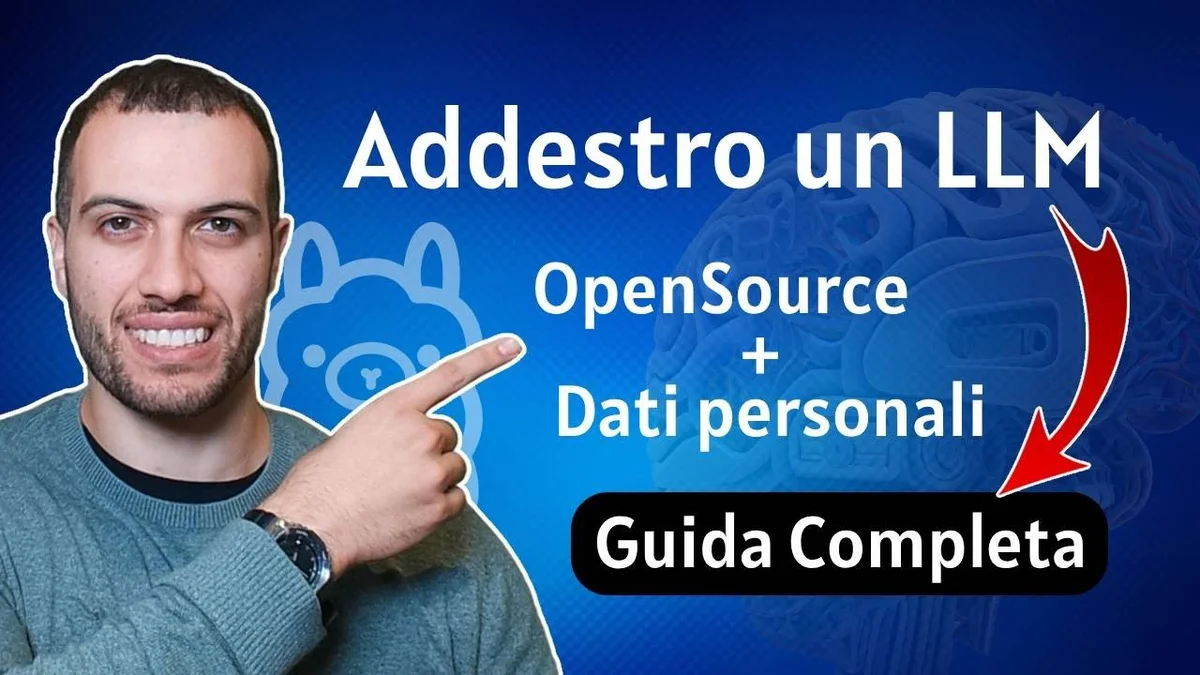
Type: Web Article Original Link: https://m.youtube.com/watch?v=UYOLlCuPFMc&pp=0gcJCY0JAYcqIYzv Publication Date: 2025-09-06
Summary#
WHAT - This is an educational tutorial that explains how to train a large language model (LLM) locally using your personal data with LLaMA 3.2.
WHY - It is relevant for AI business because it allows customizing language models without relying on cloud infrastructure, ensuring greater control over data and reducing operational costs.
WHO - The main actors are the tutorial creator, the YouTube community, and users interested in training AI models locally.
WHERE - It positions itself in the AI education market, offering resources for those who want to implement customized AI solutions in a local environment.
WHEN - The tutorial is current and is based on LLaMA 3.2, a relatively recent model, indicating a trend of growing interest in local training of AI models.
BUSINESS IMPACT:
- Opportunities: Internal training for the technical team on local LLM training, reduction of cloud infrastructure costs.
- Risks: Dependence on external tutorials for key skills, risk of obsolescence of educational content.
- Integration: Possible integration with our existing stack for training customized models.
TECHNICAL SUMMARY:
- Core technology stack: LLaMA 3.2, Go (programming language mentioned).
- Scalability: Limited to the local environment, dependent on available hardware resources.
- Technical differentiators: Focus on local training, model customization with personal data.
Use Cases#
- Private AI Stack: Integration into proprietary pipelines
- Client Solutions: Implementation for client projects
- Strategic Intelligence: Input for technological roadmap
- Competitive Analysis: Monitoring AI ecosystem
Resources#
Original Links#
Article highlighted and selected by the Human Technology eXcellence team, processed through artificial intelligence (in this case with LLM HTX-EU-Mistral3.1Small) on 2025-09-06 10:52 Original source: https://m.youtube.com/watch?v=UYOLlCuPFMc&pp=0gcJCY0JAYcqIYzv
The HTX Take#
This topic is at the heart of what we build at HTX. The technology discussed here — whether it’s about AI agents, language models, or document processing — represents exactly the kind of capability that European businesses need, but deployed on their own terms.
The challenge isn’t whether this technology works. It does. The challenge is deploying it without sending your company data to US servers, without violating GDPR, and without creating vendor dependencies you can’t escape.
That’s why we built ORCA — a private enterprise chatbot that brings these capabilities to your infrastructure. Same power as ChatGPT, but your data never leaves your perimeter. No per-user pricing, no data leakage, no compliance headaches.
Want to see how ready your company is for AI? Take our free AI Readiness Assessment — 5 minutes, personalized report, actionable roadmap.
Related Articles#
- Research Agent with Gemini 2.5 Pro and LlamaIndex | Gemini API | Google AI for Developers - AI, Go, AI Agent
- Agentic Design Patterns - Documenti Google - Go, AI Agent
- Learn Your Way - Tech
FAQ
Can large language models run on private infrastructure?
Yes. Open-source models like LLaMA, Mistral, DeepSeek, and Qwen can run on-premise or on European cloud. These models achieve performance comparable to GPT-4 for most business tasks, with the advantage of complete data sovereignty. HTX's PRISMA stack is designed to deploy these models for European SMEs.
Which LLM is best for business use?
The best model depends on your use case. For document analysis and chat, models like Mistral and LLaMA excel. For data analysis, DeepSeek offers strong reasoning. HTX's approach is model-agnostic: ORCA supports multiple models so you can choose the best fit without vendor lock-in.