
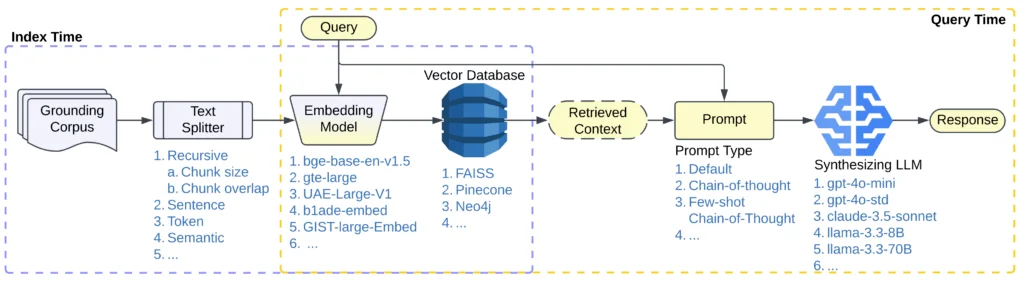
Type: Web Article Original link: https://www.datarobot.com/blog/pareto-optimized-ai-workflows-syftr/ Publication date: 2025-09-06
Summary#
WHAT - This article discusses syftr, an open-source framework for identifying Pareto-optimal GenAI workflows, balancing accuracy, cost, and latency.
WHY - It is relevant for AI business because it solves the problem of complexity in configuring AI workflows, offering a scalable method to optimize performance.
WHO - The main players are DataRobot, the company that developed syftr, and the open-source community that can contribute to and benefit from the framework.
WHERE - It positions itself in the market of AI workflow optimization tools, targeting AI development teams that need efficient solutions for configuring complex pipelines.
WHEN - Syftr is an emerging framework but already consolidated thanks to the use of advanced techniques such as Bayesian Optimization, indicating technical maturity and potential for rapid adoption.
BUSINESS IMPACT:
- Opportunities: Integration of syftr to optimize existing AI workflows, reducing costs and improving operational efficiency.
- Risks: Competition with other AI workflow optimization tools, need for team training.
- Integration: Syftr can be integrated into the existing stack to automate the search for optimal configurations, improving productivity and the quality of AI workflows.
TECHNICAL SUMMARY:
- Core technology stack: Uses multi-objective Bayesian Optimization for the search of Pareto-optimal workflows. Implemented in languages such as Rust, Go, and React.
- Scalability: Effective in managing vast configuration spaces, with an early stopping mechanism to reduce computational costs.
- Technical differentiators: Pareto Pruner for search optimization, balancing accuracy, cost, and latency, support for agentic and non-agentic workflows.
Use Cases#
- Private AI Stack: Integration into proprietary pipelines
- Client Solutions: Implementation for client projects
- Development Acceleration: Reduction of project time-to-market
- Strategic Intelligence: Input for technological roadmap
- Competitive Analysis: Monitoring AI ecosystem
Resources#
Original Links#
- Designing Pareto-optimal GenAI workflows with syftr - Original link
Article recommended and selected by the Human Technology eXcellence team, processed through artificial intelligence (in this case with LLM HTX-EU-Mistral3.1Small) on 2025-09-06 10:49 Original source: https://www.datarobot.com/blog/pareto-optimized-ai-workflows-syftr/
The HTX Take#
This topic is at the heart of what we build at HTX. The technology discussed here — whether it’s about AI agents, language models, or document processing — represents exactly the kind of capability that European businesses need, but deployed on their own terms.
The challenge isn’t whether this technology works. It does. The challenge is deploying it without sending your company data to US servers, without violating GDPR, and without creating vendor dependencies you can’t escape.
That’s why we built ORCA — a private enterprise chatbot that brings these capabilities to your infrastructure. Same power as ChatGPT, but your data never leaves your perimeter. No per-user pricing, no data leakage, no compliance headaches.
Want to see how ready your company is for AI? Take our free AI Readiness Assessment — 5 minutes, personalized report, actionable roadmap.
Related Articles#
- Strands Agents - AI Agent, AI
- MCP is eating the world—and it’s here to stay - Natural Language Processing, AI, Foundation Model
- Wren AI | Official Blog - AI
FAQ
How can AI agents benefit my business?
AI agents can automate complex multi-step tasks like data analysis, document processing, and customer interactions. For European SMEs, deploying agents on private infrastructure with tools like ORCA ensures that sensitive business data never leaves your perimeter while still leveraging cutting-edge AI capabilities.
Are AI agents safe to use with company data?
It depends on the deployment. Cloud-based agents send your data to external servers, creating GDPR risks. Private AI agents running on your own infrastructure — like those built on HTX's PRISMA stack — keep all data within your control. This is the safest approach for businesses handling sensitive information.