
Type: Web Article Original Link: https://karpathy.github.io/2026/02/12/microgpt/ Publication Date: 2026-03-02
Summary #
Introduction #
Imagine having a tool that allows you to train and infer a language model like GPT in just a few minutes, without having to manage complex infrastructures or external dependencies. This is exactly what microgpt offers, an innovative project that encapsulates the essence of a language model in a single Python file of a few lines. This tool is the result of years of work and optimization, and represents a turning point for anyone who wants to explore the world of neural networks and language models without having to deal with the typical complexity of these systems.
Microgpt was developed by Andrej Karpathy, a renowned researcher in the field of artificial intelligence, and represents a concrete example of how simplicity can be the key to understanding and innovation. This project is particularly relevant today, in an era where the demand for advanced language models is constantly growing, but the resources and skills necessary to develop them are not always accessible.
What It Does #
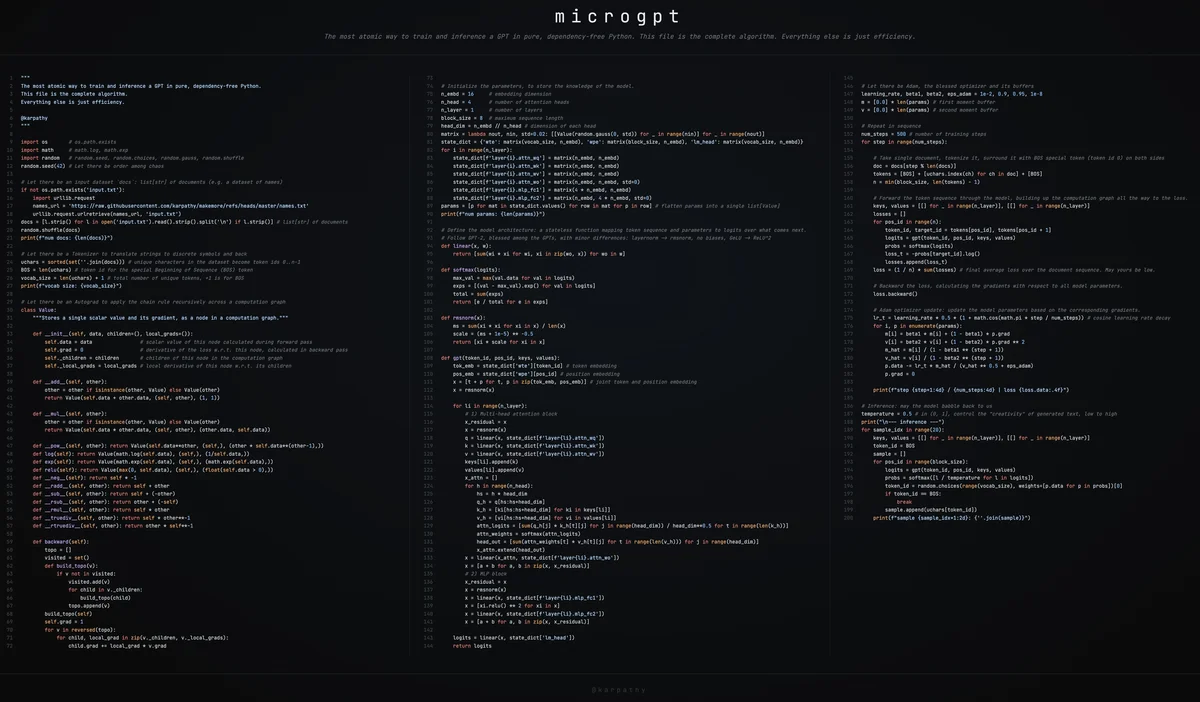
Microgpt is a project focused on creating a GPT language model in a single Python file, without external dependencies. This file contains everything needed to train and infer a language model: from the document dataset to the tokenizer, through the neural network architecture and the Adam optimizer. The project is the culmination of several previous works and represents an attempt to simplify language models as much as possible, making them accessible even to those who do not have advanced training in artificial intelligence.
In practice, microgpt is a tutorial that guides the reader through the code, explaining step by step how each component works. The dataset used is simple: a list of names, one per line. The model, once trained, is able to generate new names that follow the same statistics as the original dataset. This concrete example demonstrates how a language model can be used to generate new and plausible content starting from an initial dataset.
Why It’s Amazing #
Microgpt is relevant for several reasons. Firstly, it simplifies access to language models. Thanks to its minimalist structure, anyone can understand and experiment with a GPT model without having to deal with the typical complexity of these systems. This is particularly useful for students, researchers, and AI enthusiasts who want to deepen their knowledge without having to invest time and resources in complex infrastructures.
Efficiency and clarity. Microgpt demonstrates that it is possible to achieve significant results with simple and efficient code. This is a concrete example of how simplicity can be a strength, allowing you to focus on the essentials and better understand the underlying mechanisms. Additionally, the clarity of the code makes it easier to identify and resolve any issues, improving the robustness of the model.
Concrete examples. A practical example of using microgpt is name generation. Starting from a dataset of existing names, the model is able to generate new names that follow the same statistics. This can be useful in various contexts, such as creating characters for a video game or generating names for a social media application. Another example is text generation, such as poems or short stories, starting from a dataset of existing texts. This demonstrates how microgpt can be used to create new and original content in a simple and effective way.
Practical Applications #
Microgpt is a versatile tool that can be used in various contexts. For example, AI students can use it to better understand the mechanisms underlying language models. Thanks to its simplicity, microgpt allows you to focus on the essentials, without having to deal with the typical complexity of these systems. Additionally, researchers can use it as a basis for developing new models or testing new ideas. The clarity of the code makes it easier to identify and resolve any issues, improving the robustness of the model.
Another use case is content generation. Thanks to its ability to generate new content starting from an initial dataset, microgpt can be used to create texts, names, poems, and much more. This can be useful in various contexts, such as creating characters for a video game or generating names for a social media application. Additionally, microgpt can be used for content personalization. For example, a social media application could use microgpt to generate personalized name suggestions for its users, improving the user experience and increasing engagement.
To delve deeper, you can consult the complete code on GitHub or try the notebook on Google Colab. These resources will allow you to experiment directly with microgpt and better understand its operation.
Final Thoughts #
Microgpt represents a significant step forward in the field of language models, demonstrating that it is possible to achieve significant results with simple and efficient code. This project is a concrete example of how simplicity can be a strength, allowing you to focus on the essentials and better understand the underlying mechanisms. Additionally, microgpt is an excellent starting point for anyone who wants to explore the world of neural networks and language models, offering simple and direct access to advanced technologies.
In the context of the tech ecosystem, microgpt fits into a broader trend of simplifying and making advanced technologies accessible. This project demonstrates that it is possible to make even the most complex technologies accessible, allowing a wider audience to benefit from their potential. In the near future, we can expect to see more similar tools that make advanced technologies accessible to a wider audience, contributing to the spread of knowledge and innovation.
Use Cases #
- Private AI Stack: Integration into proprietary pipelines
- Client Solutions: Implementation for client projects
Resources #
Original Links #
- microgpt - Original link
Article recommended and selected by the Human Technology eXcellence team, elaborated through artificial intelligence (in this case with LLM HTX-EU-Mistral3.1Small) on 2026-03-02 18:18 Original source: https://karpathy.github.io/2026/02/12/microgpt/
Related Articles #
- We got Claude to fine-tune an open-source LLM. - Go, LLM, AI
- AI Explained - Stanford Research Paper.pdf - Google Drive - Go, AI
- LLMRouter - LLMRouter - AI, LLM