
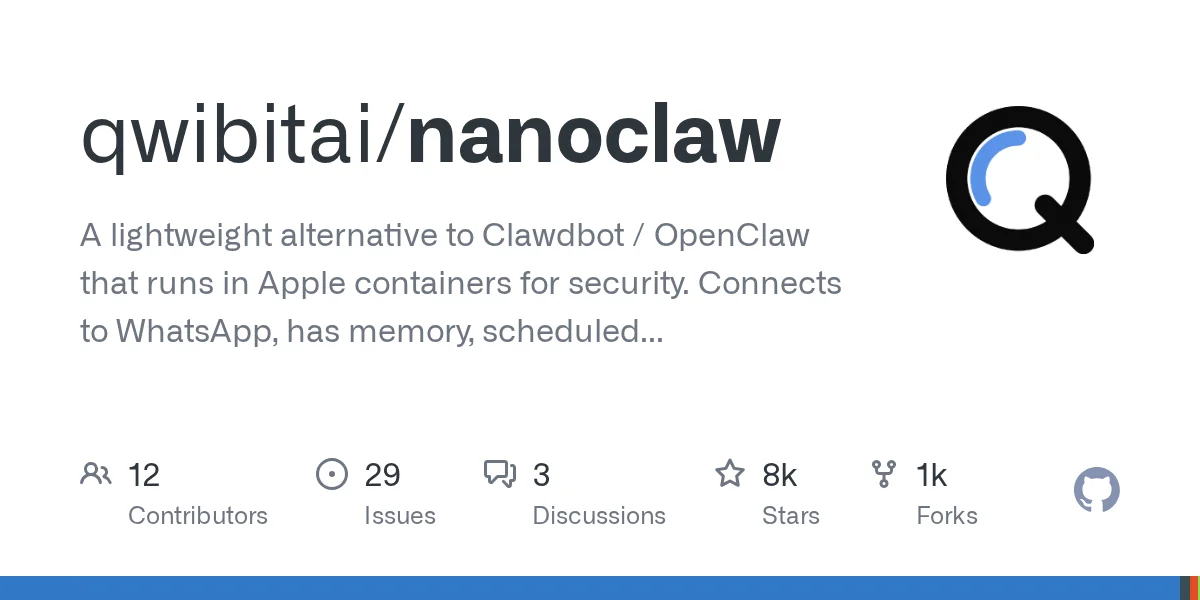
GitHub - qwibitai/nanoclaw: A lightweight alternative to Clawdbot / OpenClaw that runs in Apple containers for security. Connect

·862 words·5 mins
GitHub Open Source AI Agent AI Typescript
Articoli Interessanti - This article is part of a series.
Part : This Article
Part : How to Build an Agent - Amp **Introduction** Building an agent, especially one that leverages the power of Amp, involves several key steps. Amp, which stands for Advanced Multi-Purpose Protocol, is a versatile framework designed to enhance the capabilities of agents in various domains. This guide will walk you through the process of creating an agent using Amp, from conceptualization to deployment. **1. Define the Purpose and Scope** Before diving into the technical details, it's crucial to define the purpose and scope of your agent. Ask yourself the following questions: - What specific tasks will the agent perform? - In what environments will the agent operate? - What are the key performance metrics for success? **2. Choose the Right Tools and Technologies** Selecting the appropriate tools and technologies is essential for building a robust agent. For an Amp-based agent, you might need: - **Programming Languages**: Python, Java, or C++ are commonly used. - **Development Frameworks**: TensorFlow, PyTorch, or custom frameworks compatible with Amp. - **Data Sources**: APIs, databases, or real-time data streams. - **Communication Protocols**: HTTP, WebSockets, or other protocols supported by Amp. **3. Design the Agent Architecture** The architecture of your agent will determine its efficiency and scalability. Consider the following components: - **Input Layer**: Handles data ingestion from various sources. - **Processing Layer**: Processes the data using algorithms and models. - **Output Layer**: Delivers the results to the end-users or other systems. - **Feedback Loop**: Allows the agent to learn and improve over time. **4. Develop the Core Functionality** With the architecture in place, start developing the core functionality of your agent. This includes: - **Data Ingestion**: Implementing mechanisms to collect and preprocess data. - **Algorithm Development**: Creating or integrating algorithms that will drive the agent's decision-making. - **Model Training**: Training machine learning models if applicable. - **Integration**: Ensuring seamless integration with other systems and protocols. **5. Implement Amp Protocols** Integrate Amp protocols into your agent to leverage its advanced capabilities. This might involve: - **Protocol Implementation**: Writing code to adhere to Amp standards. - **Communication**: Ensuring the agent can communicate effectively with other Amp-compatible systems. - **Security**: Implementing security measures to protect data and communications. **6. Testing and Validation** Thoroughly test
Part : Everything as Code: How We Manage Our Company In One Monorepo At Kasava, we've embraced the concept of "everything as code" to streamline our operations and ensure consistency across our projects. This approach allows us to manage our entire company within a single monorepo, providing a unified source of truth for all our configurations, infrastructure, and applications. **Why a Monorepo?** A monorepo offers several advantages: 1. **Unified Configuration**: All our settings, from development environments to production, are stored in one place. This makes it easier to maintain consistency and reduces the risk of configuration drift. 2. **Simplified Dependency Management**: With all our code in one repository, managing dependencies becomes more straightforward. We can easily track which versions of libraries and tools are being used across different projects. 3. **Enhanced Collaboration**: A single repository fosters better collaboration among team members. Everyone has access to the same codebase, making it easier to share knowledge and work together on projects. 4. **Consistent Build and Deployment Processes**: By standardizing our build and deployment processes, we ensure that all our applications follow the same best practices. This leads to more reliable and predictable deployments. **Our Monorepo Structure** Our monorepo is organized into several key directories: - **/config**: Contains all configuration files for various environments, including development, staging, and production. - **/infrastructure**: Houses the infrastructure as code (IaC) scripts for provisioning and managing our cloud resources. - **/apps**: Includes all our applications, both internal tools and customer-facing products. - **/lib**: Stores reusable libraries and modules that can be shared across different projects. - **/scripts**: Contains utility scripts for automating various tasks, such as data migrations and backups. **Tools and Technologies** To manage our monorepo effectively, we use a combination of tools and technologies: - **Version Control**: Git is our primary version control system, and we use GitHub for hosting our repositories. - **Continuous Integration/Continuous Deployment (CI/CD)**: We employ Jenkins for automating our build, test, and deployment processes. - **Infrastructure as Code (IaC)**: Terraform is our tool of choice for managing cloud infrastructure. - **Configuration Management**: Ansible is used for configuring and managing our servers and applications. - **Monitoring and Logging**: We use Prometheus and Grafana for monitoring,
Part : Introduction to the MCP Toolbox for Databases The MCP Toolbox for Databases is a comprehensive suite of tools designed to facilitate the management, optimization, and maintenance of databases. This toolbox is tailored to support a wide range of database management systems (DBMS), ensuring compatibility and efficiency across various platforms. Whether you are a database administrator, developer, or analyst, the MCP Toolbox provides a robust set of features to streamline your workflow and enhance productivity. Key Features: 1. **Database Management**: Easily create, modify, and delete databases and tables. The toolbox offers intuitive interfaces and powerful scripting capabilities to manage database schemas and objects efficiently. 2. **Performance Optimization**: Identify and resolve performance bottlenecks with advanced diagnostic tools. The MCP Toolbox includes performance monitoring and tuning features to ensure your databases run smoothly and efficiently. 3. **Backup and Recovery**: Implement reliable backup and recovery solutions to safeguard your data. The toolbox provides automated backup schedules and comprehensive recovery options to protect against data loss. 4. **Security Management**: Enhance database security with robust access control and encryption features. The MCP Toolbox helps you manage user permissions, audit logs, and secure data transmission. 5. **Data Integration**: Seamlessly integrate data from multiple sources and formats. The toolbox supports various data integration techniques, including ETL (Extract, Transform, Load) processes, to consolidate and analyze data effectively. 6. **Reporting and Analytics**: Generate insightful reports and perform in-depth data analysis. The MCP Toolbox offers advanced reporting tools and analytics capabilities to derive actionable insights from your data. 7. **Cross-Platform Compatibility**: Ensure compatibility with multiple DBMS platforms, including popular systems like Oracle, SQL Server, MySQL, and PostgreSQL. The toolbox is designed to work seamlessly across different environments. 8. **User-Friendly Interface**: Benefit from an intuitive and user-friendly interface that simplifies complex database tasks. The MCP Toolbox is designed with ease of use in mind, making it accessible to both novice and experienced users. The MCP Toolbox for Databases is an essential tool for anyone involved in database management. Its comprehensive features and cross-platform compatibility make it a valuable asset for optimizing database performance, ensuring data security, and enhancing overall productivity.
nanoclaw repository preview
#### Source

Type: GitHub Repository Original Link: https://github.com/gavrielc/nanoclaw Publication Date: 2026-02-14


Summary
#

Introduction
#

Imagine you are a marketing professional managing campaigns across multiple channels, including WhatsApp. Every day, you receive hundreds of messages and need to respond promptly and personally. Additionally, you need to monitor sales, update project documents, and coordinate with your team. All of this can quickly become unmanageable without a reliable assistant.

This is where NanoClaw comes into play. This revolutionary project is a lightweight AI assistant that integrates seamlessly with WhatsApp, offering advanced features such as memory, scheduled tasks, and container execution for enhanced security. With NanoClaw, you can automate many of your daily tasks, freeing up valuable time to focus on what truly matters.

NanoClaw was created to be understandable and customizable, allowing you to adapt it to your specific needs. It’s not just another AI tool; it’s an assistant that can truly make a difference in your daily workflow.

What It Does
#

NanoClaw is a lightweight AI assistant that runs in containers to ensure maximum security. It is designed to be simple to understand and customize, offering advanced features such as WhatsApp connection, memory to remember conversations, scheduled tasks, and execution on Anthropic’s Agents SDK.

Think of NanoClaw as a personal assistant that can manage your WhatsApp communications, remember important details, and perform automatic tasks. For example, you can schedule NanoClaw to send you a sales summary every morning or update project documents based on the latest changes. All of this without having to configure complex microservices or message queues.

Why It’s Amazing
#

The “wow” factor of NanoClaw lies in its simplicity and security. It’s not just an AI assistant; it’s a system that can be understood and customized in just a few minutes. Here are some of the features that make it amazing:

Dynamic and contextual: NanoClaw can handle WhatsApp conversations dynamically and contextually. For example, you can schedule NanoClaw to send you a sales summary every morning at 9:00. “Hello, I am your system. Here is today’s sales summary: 100 units sold, with a 15% increase compared to yesterday.” This type of customization makes NanoClaw a truly useful assistant.

Real-time reasoning: NanoClaw can perform scheduled tasks and respond in real-time. For example, you can schedule NanoClaw to review the Git history every Friday and update the README if there are significant changes. “Hello, I noticed there have been some changes in the Git history. I have updated the README accordingly.”

Security and isolation: NanoClaw runs agents in Linux containers (or Apple Containers on macOS), ensuring that each agent has its own isolated environment. This means that each conversation group has its own memory and filesystem, minimizing security risks.

Customization through code: NanoClaw is designed to be customized directly through code. If you need specific behavior, you can modify the source code without having to navigate through complex configurations. This approach makes NanoClaw extremely flexible and adaptable to your needs.

How to Try It
#

To get started with NanoClaw, follow these steps:

  1. Clone the repository: Start by cloning the repository from GitHub. Open the terminal and type:

    git clone https://github.com/gavrielc/nanoclaw.git
    cd nanoclaw
    
  2. Run the setup: Once the repository is cloned, run the claude command and then /setup. Claude Code will handle the rest, including dependencies, authentication, container, and service configuration.

  3. Consult the documentation: For more details, consult the README and the official documentation. There is no one-click demo, but the setup process is well-documented and guided.

Final Thoughts
#

NanoClaw represents a significant step forward in the world of AI assistants. Its simplicity, security, and flexibility make it a valuable tool for anyone looking to automate and improve their workflow. The NanoClaw community is active and collaborative, making it easy to find support and contribute to the project.

In a world increasingly dependent on automation and artificial intelligence, NanoClaw offers a solution that is both powerful and accessible. Whether you are a marketing professional, a developer, or a technology enthusiast, NanoClaw has the potential to transform the way you work. Try it today and discover how it can enhance your productivity and security.


Use Cases
#

  • Private AI Stack: Integration into proprietary pipelines
  • Client Solutions: Implementation for client projects
  • Development Acceleration: Reduction of project time-to-market
  • Strategic Intelligence: Input for technological roadmap
  • Competitive Analysis: Monitoring AI ecosystem

Third-Party Feedback
#

Community feedback: Users appreciate the project but express concerns about security and the use of AI for documentation, suggesting writing guides manually for greater reliability.

Full discussion


Resources
#

Original Links #


Article recommended and selected by the Human Technology eXcellence team, processed through artificial intelligence (in this case with LLM HTX-EU-Mistral3.1Small) on 2026-02-14 10:08 Original source: https://github.com/gavrielc/nanoclaw

Related Articles #

Articoli Interessanti - This article is part of a series.
Part : This Article
Part : How to Build an Agent - Amp **Introduction** Building an agent, especially one that leverages the power of Amp, involves several key steps. Amp, which stands for Advanced Multi-Purpose Protocol, is a versatile framework designed to enhance the capabilities of agents in various domains. This guide will walk you through the process of creating an agent using Amp, from conceptualization to deployment. **1. Define the Purpose and Scope** Before diving into the technical details, it's crucial to define the purpose and scope of your agent. Ask yourself the following questions: - What specific tasks will the agent perform? - In what environments will the agent operate? - What are the key performance metrics for success? **2. Choose the Right Tools and Technologies** Selecting the appropriate tools and technologies is essential for building a robust agent. For an Amp-based agent, you might need: - **Programming Languages**: Python, Java, or C++ are commonly used. - **Development Frameworks**: TensorFlow, PyTorch, or custom frameworks compatible with Amp. - **Data Sources**: APIs, databases, or real-time data streams. - **Communication Protocols**: HTTP, WebSockets, or other protocols supported by Amp. **3. Design the Agent Architecture** The architecture of your agent will determine its efficiency and scalability. Consider the following components: - **Input Layer**: Handles data ingestion from various sources. - **Processing Layer**: Processes the data using algorithms and models. - **Output Layer**: Delivers the results to the end-users or other systems. - **Feedback Loop**: Allows the agent to learn and improve over time. **4. Develop the Core Functionality** With the architecture in place, start developing the core functionality of your agent. This includes: - **Data Ingestion**: Implementing mechanisms to collect and preprocess data. - **Algorithm Development**: Creating or integrating algorithms that will drive the agent's decision-making. - **Model Training**: Training machine learning models if applicable. - **Integration**: Ensuring seamless integration with other systems and protocols. **5. Implement Amp Protocols** Integrate Amp protocols into your agent to leverage its advanced capabilities. This might involve: - **Protocol Implementation**: Writing code to adhere to Amp standards. - **Communication**: Ensuring the agent can communicate effectively with other Amp-compatible systems. - **Security**: Implementing security measures to protect data and communications. **6. Testing and Validation** Thoroughly test
Part : Everything as Code: How We Manage Our Company In One Monorepo At Kasava, we've embraced the concept of "everything as code" to streamline our operations and ensure consistency across our projects. This approach allows us to manage our entire company within a single monorepo, providing a unified source of truth for all our configurations, infrastructure, and applications. **Why a Monorepo?** A monorepo offers several advantages: 1. **Unified Configuration**: All our settings, from development environments to production, are stored in one place. This makes it easier to maintain consistency and reduces the risk of configuration drift. 2. **Simplified Dependency Management**: With all our code in one repository, managing dependencies becomes more straightforward. We can easily track which versions of libraries and tools are being used across different projects. 3. **Enhanced Collaboration**: A single repository fosters better collaboration among team members. Everyone has access to the same codebase, making it easier to share knowledge and work together on projects. 4. **Consistent Build and Deployment Processes**: By standardizing our build and deployment processes, we ensure that all our applications follow the same best practices. This leads to more reliable and predictable deployments. **Our Monorepo Structure** Our monorepo is organized into several key directories: - **/config**: Contains all configuration files for various environments, including development, staging, and production. - **/infrastructure**: Houses the infrastructure as code (IaC) scripts for provisioning and managing our cloud resources. - **/apps**: Includes all our applications, both internal tools and customer-facing products. - **/lib**: Stores reusable libraries and modules that can be shared across different projects. - **/scripts**: Contains utility scripts for automating various tasks, such as data migrations and backups. **Tools and Technologies** To manage our monorepo effectively, we use a combination of tools and technologies: - **Version Control**: Git is our primary version control system, and we use GitHub for hosting our repositories. - **Continuous Integration/Continuous Deployment (CI/CD)**: We employ Jenkins for automating our build, test, and deployment processes. - **Infrastructure as Code (IaC)**: Terraform is our tool of choice for managing cloud infrastructure. - **Configuration Management**: Ansible is used for configuring and managing our servers and applications. - **Monitoring and Logging**: We use Prometheus and Grafana for monitoring,
Part : Introduction to the MCP Toolbox for Databases The MCP Toolbox for Databases is a comprehensive suite of tools designed to facilitate the management, optimization, and maintenance of databases. This toolbox is tailored to support a wide range of database management systems (DBMS), ensuring compatibility and efficiency across various platforms. Whether you are a database administrator, developer, or analyst, the MCP Toolbox provides a robust set of features to streamline your workflow and enhance productivity. Key Features: 1. **Database Management**: Easily create, modify, and delete databases and tables. The toolbox offers intuitive interfaces and powerful scripting capabilities to manage database schemas and objects efficiently. 2. **Performance Optimization**: Identify and resolve performance bottlenecks with advanced diagnostic tools. The MCP Toolbox includes performance monitoring and tuning features to ensure your databases run smoothly and efficiently. 3. **Backup and Recovery**: Implement reliable backup and recovery solutions to safeguard your data. The toolbox provides automated backup schedules and comprehensive recovery options to protect against data loss. 4. **Security Management**: Enhance database security with robust access control and encryption features. The MCP Toolbox helps you manage user permissions, audit logs, and secure data transmission. 5. **Data Integration**: Seamlessly integrate data from multiple sources and formats. The toolbox supports various data integration techniques, including ETL (Extract, Transform, Load) processes, to consolidate and analyze data effectively. 6. **Reporting and Analytics**: Generate insightful reports and perform in-depth data analysis. The MCP Toolbox offers advanced reporting tools and analytics capabilities to derive actionable insights from your data. 7. **Cross-Platform Compatibility**: Ensure compatibility with multiple DBMS platforms, including popular systems like Oracle, SQL Server, MySQL, and PostgreSQL. The toolbox is designed to work seamlessly across different environments. 8. **User-Friendly Interface**: Benefit from an intuitive and user-friendly interface that simplifies complex database tasks. The MCP Toolbox is designed with ease of use in mind, making it accessible to both novice and experienced users. The MCP Toolbox for Databases is an essential tool for anyone involved in database management. Its comprehensive features and cross-platform compatibility make it a valuable asset for optimizing database performance, ensuring data security, and enhancing overall productivity.