
Dr Milan Milanović (@milan_milanovic) on X

·562 words·3 mins
Articoli Tech
Articoli Interessanti - This article is part of a series.
Part : Everything as Code: How We Manage Our Company In One Monorepo At Kasava, we've embraced the concept of "everything as code" to streamline our operations and ensure consistency across our projects. This approach allows us to manage our entire company within a single monorepo, providing a unified source of truth for all our configurations, infrastructure, and applications. **Why a Monorepo?** A monorepo offers several advantages: 1. **Unified Configuration**: All our settings, from development environments to production, are stored in one place. This makes it easier to maintain consistency and reduces the risk of configuration drift. 2. **Simplified Dependency Management**: With all our code in one repository, managing dependencies becomes more straightforward. We can easily track which versions of libraries and tools are being used across different projects. 3. **Enhanced Collaboration**: A single repository fosters better collaboration among team members. Everyone has access to the same codebase, making it easier to share knowledge and work together on projects. 4. **Consistent Build and Deployment Processes**: By standardizing our build and deployment processes, we ensure that all our applications follow the same best practices. This leads to more reliable and predictable deployments. **Our Monorepo Structure** Our monorepo is organized into several key directories: - **/config**: Contains all configuration files for various environments, including development, staging, and production. - **/infrastructure**: Houses the infrastructure as code (IaC) scripts for provisioning and managing our cloud resources. - **/apps**: Includes all our applications, both internal tools and customer-facing products. - **/lib**: Stores reusable libraries and modules that can be shared across different projects. - **/scripts**: Contains utility scripts for automating various tasks, such as data migrations and backups. **Tools and Technologies** To manage our monorepo effectively, we use a combination of tools and technologies: - **Version Control**: Git is our primary version control system, and we use GitHub for hosting our repositories. - **Continuous Integration/Continuous Deployment (CI/CD)**: We employ Jenkins for automating our build, test, and deployment processes. - **Infrastructure as Code (IaC)**: Terraform is our tool of choice for managing cloud infrastructure. - **Configuration Management**: Ansible is used for configuring and managing our servers and applications. - **Monitoring and Logging**: We use Prometheus and Grafana for monitoring,
Part : This Article
Featured image
#### Source

Type: Content Original link: https://x.com/milan_milanovic/status/1980966619343142980?s=43&t=ANuJI-IuN5rdsaLueycEbA Publication date: 2025-10-24


Summary
#

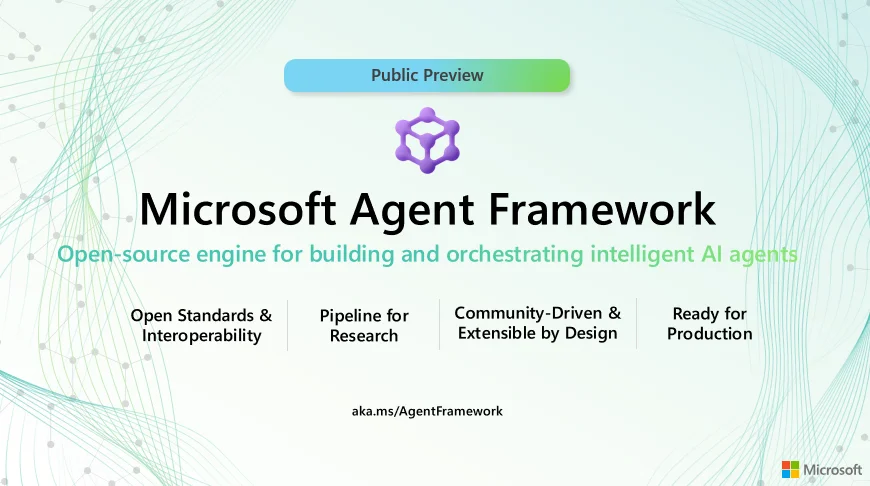
Microsoft Agent Framework
#

WHAT - Microsoft Agent Framework is an open-source framework for building, orchestrating, and distributing AI agents and multi-agent workflows, supporting Python and .NET.

WHY - It is relevant for AI business because it allows the creation of autonomous agents that can reason about goals, call tools and APIs, collaborate with other agents, and adapt dynamically, solving complex problems of automation and integration.

WHO - The main players are Microsoft, the open-source community, and developers experimenting with AI agents.

WHERE - It positions itself in the market of tools for AI agent development, integrating with the Azure ecosystem and supporting languages such as Python and .NET.

WHEN - It is a relatively new but rapidly growing project, with an active and expanding user base.

BUSINESS IMPACT:

  • Opportunities: Integration with the existing stack to create advanced AI agents, improving business process automation.
  • Risks: Competition with other open-source frameworks and proprietary AI agent solutions.
  • Integration: Possible integration with Azure services to expand automation and orchestration capabilities.

TECHNICAL SUMMARY:

  • Core technology stack: Python, .NET, AI agent SDK, support for multi-agent workflows.
  • Scalability: High scalability thanks to support for multi-agent workflow orchestration.
  • Limitations: Dependence on the Azure ecosystem for some advanced features.
  • Technical differentiators: Support for autonomous agents that can reason about goals and adapt dynamically, integration with various tools and APIs.

Introducing Microsoft Agent Framework: The Open-Source Engine for Agentic AI Apps
#

WHAT - Azure AI Foundry blog post about the Microsoft Agent Framework, explaining the need for a new base for AI agents.

WHY - It is relevant for AI business because it explains how AI agents are evolving beyond simple chatbots and copilots, becoming autonomous software components capable of reasoning about goals and collaborating with other agents.

WHO - The main players are Microsoft, developers experimenting with AI agents, and the open-source community.

WHERE - It positions itself in the market of information and best practices for AI agent development, integrating with the Azure ecosystem.

WHEN - It is a recent article that reflects current and future trends in AI agent development.

BUSINESS IMPACT:

  • Opportunities: Understanding trends and best practices for AI agent development, improving business strategy.
  • Risks: Competition with other AI agent solutions and frameworks.
  • Integration: Possible integration with acquired knowledge to improve the existing technology stack.

TECHNICAL SUMMARY:

  • Core technology stack: Discussion on autonomous AI agents, multi-agent workflow orchestration, integration with tools and APIs.
  • Scalability: Not directly applicable, but provides insights into how to scale AI agent solutions.
  • Limitations: Dependence on the information provided, which may not cover all technical aspects.
  • Technical differentiators: Focus on autonomous and collaborative AI agents that can reason about goals and adapt dynamically.

Use Cases
#

  • Private AI Stack: Integration into proprietary pipelines
  • Client Solutions: Implementation for client projects
  • Development Acceleration: Reduction of project time-to-market
  • Strategic Intelligence: Input for technological roadmap
  • Competitive Analysis: Monitoring AI ecosystem

Resources
#

Original Links #


Article suggested and selected by the Human Technology eXcellence team, elaborated through artificial intelligence (in this case with LLM HTX-EU-Mistral3.1Small) on 2025-10-24 08:29 Original source: https://x.com/milan_milanovic/status/1980966619343142980?s=43&t=ANuJI-IuN5rdsaLueycEbA

Related Articles #

Articoli Interessanti - This article is part of a series.
Part : Everything as Code: How We Manage Our Company In One Monorepo At Kasava, we've embraced the concept of "everything as code" to streamline our operations and ensure consistency across our projects. This approach allows us to manage our entire company within a single monorepo, providing a unified source of truth for all our configurations, infrastructure, and applications. **Why a Monorepo?** A monorepo offers several advantages: 1. **Unified Configuration**: All our settings, from development environments to production, are stored in one place. This makes it easier to maintain consistency and reduces the risk of configuration drift. 2. **Simplified Dependency Management**: With all our code in one repository, managing dependencies becomes more straightforward. We can easily track which versions of libraries and tools are being used across different projects. 3. **Enhanced Collaboration**: A single repository fosters better collaboration among team members. Everyone has access to the same codebase, making it easier to share knowledge and work together on projects. 4. **Consistent Build and Deployment Processes**: By standardizing our build and deployment processes, we ensure that all our applications follow the same best practices. This leads to more reliable and predictable deployments. **Our Monorepo Structure** Our monorepo is organized into several key directories: - **/config**: Contains all configuration files for various environments, including development, staging, and production. - **/infrastructure**: Houses the infrastructure as code (IaC) scripts for provisioning and managing our cloud resources. - **/apps**: Includes all our applications, both internal tools and customer-facing products. - **/lib**: Stores reusable libraries and modules that can be shared across different projects. - **/scripts**: Contains utility scripts for automating various tasks, such as data migrations and backups. **Tools and Technologies** To manage our monorepo effectively, we use a combination of tools and technologies: - **Version Control**: Git is our primary version control system, and we use GitHub for hosting our repositories. - **Continuous Integration/Continuous Deployment (CI/CD)**: We employ Jenkins for automating our build, test, and deployment processes. - **Infrastructure as Code (IaC)**: Terraform is our tool of choice for managing cloud infrastructure. - **Configuration Management**: Ansible is used for configuring and managing our servers and applications. - **Monitoring and Logging**: We use Prometheus and Grafana for monitoring,
Part : This Article