
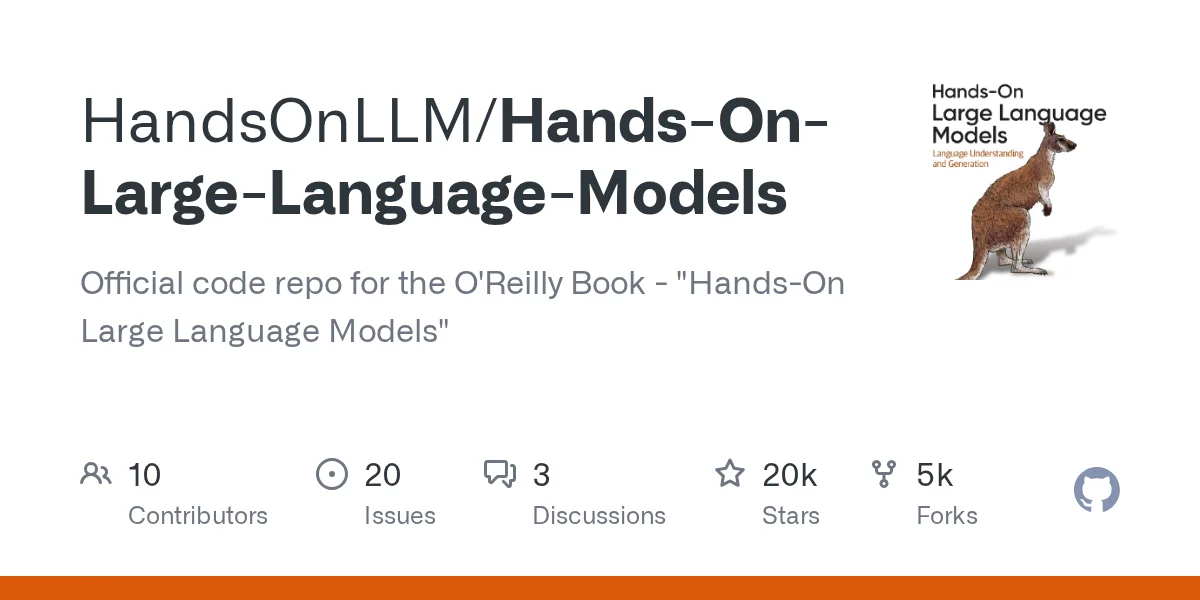
GitHub - HandsOnLLM/Hands-On-Large-Language-Models: Official code repository for the O'Reilly Book - 'Hands-On Large Language Models'

·1196 words·6 mins
GitHub LLM Open Source Foundation Model
Articoli Interessanti - This article is part of a series.
Part : How to Build an Agent - Amp **Introduction** Building an agent, especially one that leverages the power of Amp, involves several key steps. Amp, which stands for Advanced Multi-Purpose Protocol, is a versatile framework designed to enhance the capabilities of agents in various domains. This guide will walk you through the process of creating an agent using Amp, from conceptualization to deployment. **1. Define the Purpose and Scope** Before diving into the technical details, it's crucial to define the purpose and scope of your agent. Ask yourself the following questions: - What specific tasks will the agent perform? - In what environments will the agent operate? - What are the key performance metrics for success? **2. Choose the Right Tools and Technologies** Selecting the appropriate tools and technologies is essential for building a robust agent. For an Amp-based agent, you might need: - **Programming Languages**: Python, Java, or C++ are commonly used. - **Development Frameworks**: TensorFlow, PyTorch, or custom frameworks compatible with Amp. - **Data Sources**: APIs, databases, or real-time data streams. - **Communication Protocols**: HTTP, WebSockets, or other protocols supported by Amp. **3. Design the Agent Architecture** The architecture of your agent will determine its efficiency and scalability. Consider the following components: - **Input Layer**: Handles data ingestion from various sources. - **Processing Layer**: Processes the data using algorithms and models. - **Output Layer**: Delivers the results to the end-users or other systems. - **Feedback Loop**: Allows the agent to learn and improve over time. **4. Develop the Core Functionality** With the architecture in place, start developing the core functionality of your agent. This includes: - **Data Ingestion**: Implementing mechanisms to collect and preprocess data. - **Algorithm Development**: Creating or integrating algorithms that will drive the agent's decision-making. - **Model Training**: Training machine learning models if applicable. - **Integration**: Ensuring seamless integration with other systems and protocols. **5. Implement Amp Protocols** Integrate Amp protocols into your agent to leverage its advanced capabilities. This might involve: - **Protocol Implementation**: Writing code to adhere to Amp standards. - **Communication**: Ensuring the agent can communicate effectively with other Amp-compatible systems. - **Security**: Implementing security measures to protect data and communications. **6. Testing and Validation** Thoroughly test
Part : Everything as Code: How We Manage Our Company In One Monorepo At Kasava, we've embraced the concept of "everything as code" to streamline our operations and ensure consistency across our projects. This approach allows us to manage our entire company within a single monorepo, providing a unified source of truth for all our configurations, infrastructure, and applications. **Why a Monorepo?** A monorepo offers several advantages: 1. **Unified Configuration**: All our settings, from development environments to production, are stored in one place. This makes it easier to maintain consistency and reduces the risk of configuration drift. 2. **Simplified Dependency Management**: With all our code in one repository, managing dependencies becomes more straightforward. We can easily track which versions of libraries and tools are being used across different projects. 3. **Enhanced Collaboration**: A single repository fosters better collaboration among team members. Everyone has access to the same codebase, making it easier to share knowledge and work together on projects. 4. **Consistent Build and Deployment Processes**: By standardizing our build and deployment processes, we ensure that all our applications follow the same best practices. This leads to more reliable and predictable deployments. **Our Monorepo Structure** Our monorepo is organized into several key directories: - **/config**: Contains all configuration files for various environments, including development, staging, and production. - **/infrastructure**: Houses the infrastructure as code (IaC) scripts for provisioning and managing our cloud resources. - **/apps**: Includes all our applications, both internal tools and customer-facing products. - **/lib**: Stores reusable libraries and modules that can be shared across different projects. - **/scripts**: Contains utility scripts for automating various tasks, such as data migrations and backups. **Tools and Technologies** To manage our monorepo effectively, we use a combination of tools and technologies: - **Version Control**: Git is our primary version control system, and we use GitHub for hosting our repositories. - **Continuous Integration/Continuous Deployment (CI/CD)**: We employ Jenkins for automating our build, test, and deployment processes. - **Infrastructure as Code (IaC)**: Terraform is our tool of choice for managing cloud infrastructure. - **Configuration Management**: Ansible is used for configuring and managing our servers and applications. - **Monitoring and Logging**: We use Prometheus and Grafana for monitoring,
Part : Introduction to the MCP Toolbox for Databases The MCP Toolbox for Databases is a comprehensive suite of tools designed to facilitate the management, optimization, and maintenance of databases. This toolbox is tailored to support a wide range of database management systems (DBMS), ensuring compatibility and efficiency across various platforms. Whether you are a database administrator, developer, or analyst, the MCP Toolbox provides a robust set of features to streamline your workflow and enhance productivity. Key Features: 1. **Database Management**: Easily create, modify, and delete databases and tables. The toolbox offers intuitive interfaces and powerful scripting capabilities to manage database schemas and objects efficiently. 2. **Performance Optimization**: Identify and resolve performance bottlenecks with advanced diagnostic tools. The MCP Toolbox includes performance monitoring and tuning features to ensure your databases run smoothly and efficiently. 3. **Backup and Recovery**: Implement reliable backup and recovery solutions to safeguard your data. The toolbox provides automated backup schedules and comprehensive recovery options to protect against data loss. 4. **Security Management**: Enhance database security with robust access control and encryption features. The MCP Toolbox helps you manage user permissions, audit logs, and secure data transmission. 5. **Data Integration**: Seamlessly integrate data from multiple sources and formats. The toolbox supports various data integration techniques, including ETL (Extract, Transform, Load) processes, to consolidate and analyze data effectively. 6. **Reporting and Analytics**: Generate insightful reports and perform in-depth data analysis. The MCP Toolbox offers advanced reporting tools and analytics capabilities to derive actionable insights from your data. 7. **Cross-Platform Compatibility**: Ensure compatibility with multiple DBMS platforms, including popular systems like Oracle, SQL Server, MySQL, and PostgreSQL. The toolbox is designed to work seamlessly across different environments. 8. **User-Friendly Interface**: Benefit from an intuitive and user-friendly interface that simplifies complex database tasks. The MCP Toolbox is designed with ease of use in mind, making it accessible to both novice and experienced users. The MCP Toolbox for Databases is an essential tool for anyone involved in database management. Its comprehensive features and cross-platform compatibility make it a valuable asset for optimizing database performance, ensuring data security, and enhancing overall productivity.
Part : This Article
Hands-On-Large-Language-Models repository preview
#### Source

Type: GitHub Repository Original link: https://github.com/HandsOnLLM/Hands-On-Large-Language-Models?tab=readme-ov-file Publication date: 2026-01-28


Summary
#

Introduction
#

Imagine you are a data scientist who needs to analyze a huge dataset of product reviews. You need to extract useful information, such as customer opinions on various aspects of the product, but the dataset is too large to be managed manually. Or, imagine you are a machine learning engineer who needs to develop a chatbot system for an e-commerce company. The chatbot must be able to answer complex customer questions in real-time, but you have no idea where to start.

These are just two examples of situations where large language models (LLM) can make a difference. LLMs are artificial intelligence models that can understand and generate text in a way very similar to a human. However, working with these models can be complex and requires in-depth knowledge of various concepts and tools. This is where the “Hands-On Large Language Models” project comes into play.

This project, available on GitHub, is the official repository of the O’Reilly book “Hands-On Large Language Models.” It offers a practical and visually educational approach to learning how to use LLMs. With nearly 300 custom figures, the book and the repository guide you through the fundamental concepts and practical tools needed to work with LLMs today. Thanks to this project, you can transform complex data into useful information and create advanced artificial intelligence systems in a simple and intuitive way.

What It Does
#

The “Hands-On Large Language Models” project is a repository that contains the code for all the examples in the eponymous book. The repository is structured into various chapters, each covering a specific topic related to LLMs. For example, there are chapters dedicated to the introduction to language models, tokens and embeddings, text classification, prompt engineering, and much more.

The project primarily uses Jupyter Notebook, an interactive development environment that allows you to run Python code and view the results in real-time. This makes the learning process much more interactive and accessible, especially for those new to the field of LLMs. Additionally, the repository includes detailed guides for installing and configuring the working environment, making it easy for anyone to start working with LLMs.

Why It’s Amazing
#

The “wow” factor of this project lies in its ability to make complex concepts accessible through a practical and visually educational approach. It is not just a textbook or a code repository: it is a complete learning experience that guides you step-by-step into the world of LLMs.

Dynamic and contextual:
#

One of the most amazing aspects of this project is its dynamic and contextual nature. Each example in the repository is designed to be run in an interactive environment, such as Google Colab. This means you can immediately see the results of your code and understand how LLMs work in practice. For example, in the chapter dedicated to text classification, you can load your dataset of reviews and see how the model automatically classifies customer opinions. This approach makes learning much more engaging and effective.

Real-time reasoning:
#

Another strength of the project is its ability to enable real-time reasoning. Thanks to the use of Jupyter Notebook and Google Colab, you can run the code and see the results in real-time. This is particularly useful when working with large language models, which can be complex and difficult to understand. For example, you can load a pre-trained model and see how it responds to different questions in real-time. This allows you to experiment and better understand how LLMs work.

Concrete examples and practical applications:
#

The project is rich in concrete examples and practical applications. Each chapter includes real examples that show you how to apply theoretical concepts to real-world problems. For example, in the chapter dedicated to text generation, you can see how to create a chatbot that answers complex customer questions. Or, in the chapter dedicated to semantic search, you can see how to improve information retrieval in a dataset of documents. These concrete examples make the project much more useful and applicable to real life.

Community and support:
#

Finally, the project benefits from an active community and continuous support. The authors of the book and the repository are actively involved in the community and respond to user questions and feedback. This makes the project much more reliable and supported, making it easier for anyone to start working with LLMs.

How to Try It
#

To start working with the “Hands-On Large Language Models” project, follow these steps:

  1. Clone the repository: You can find the code on GitHub at the following address: Hands-On Large Language Models. Clone the repository to your computer using the command git clone https://github.com/HandsOnLLM/Hands-On-Large-Language-Models.git.

  2. Prerequisites: Make sure you have Python installed on your computer. Additionally, we recommend using Google Colab to run the notebooks, as it offers a free and powerful development environment with GPU access.

  3. Setup: Follow the instructions in the .setup/ folder to install all necessary dependencies. You can find a complete guide on how to configure the working environment in the .setup/conda/ folder.

  4. Documentation: The main documentation is available in the repository and in the book “Hands-On Large Language Models.” We recommend reading the documentation carefully to better understand how to use the project.

There is no one-click demo, but the setup process is well-documented and easy to follow. Once the environment is configured, you can start exploring the various chapters and running the interactive examples.

Final Thoughts
#

The “Hands-On Large Language Models” project represents a significant step forward in how we can learn and work with large language models. Thanks to its practical and visually educational approach, it makes complex concepts accessible to a wider audience. This is particularly important in an era where artificial intelligence is becoming increasingly central in various sectors.

The project not only teaches you how to use LLMs but also shows you how to apply them to real-world problems. This makes it a valuable resource for data scientists, machine learning engineers, and anyone interested in exploring the potential of LLMs.

In conclusion, “Hands-On Large Language Models” is a project that has the potential to revolutionize the way we learn and work with artificial intelligence. With its active community and continuous support, it is a project worth exploring and adopting. Happy work and happy exploration!


Use Cases
#

  • Private AI Stack: Integration into proprietary pipelines
  • Client Solutions: Implementation for client projects
  • Development Acceleration: Reduction of time-to-market for projects

Resources
#

Original Links #


Article recommended and selected by the Human Technology eXcellence team, processed through artificial intelligence (in this case with LLM HTX-EU-Mistral3.1Small) on 2026-01-28 07:49 Original source: https://github.com/HandsOnLLM/Hands-On-Large-Language-Models?tab=readme-ov-file

Related Articles #

Articoli Interessanti - This article is part of a series.
Part : How to Build an Agent - Amp **Introduction** Building an agent, especially one that leverages the power of Amp, involves several key steps. Amp, which stands for Advanced Multi-Purpose Protocol, is a versatile framework designed to enhance the capabilities of agents in various domains. This guide will walk you through the process of creating an agent using Amp, from conceptualization to deployment. **1. Define the Purpose and Scope** Before diving into the technical details, it's crucial to define the purpose and scope of your agent. Ask yourself the following questions: - What specific tasks will the agent perform? - In what environments will the agent operate? - What are the key performance metrics for success? **2. Choose the Right Tools and Technologies** Selecting the appropriate tools and technologies is essential for building a robust agent. For an Amp-based agent, you might need: - **Programming Languages**: Python, Java, or C++ are commonly used. - **Development Frameworks**: TensorFlow, PyTorch, or custom frameworks compatible with Amp. - **Data Sources**: APIs, databases, or real-time data streams. - **Communication Protocols**: HTTP, WebSockets, or other protocols supported by Amp. **3. Design the Agent Architecture** The architecture of your agent will determine its efficiency and scalability. Consider the following components: - **Input Layer**: Handles data ingestion from various sources. - **Processing Layer**: Processes the data using algorithms and models. - **Output Layer**: Delivers the results to the end-users or other systems. - **Feedback Loop**: Allows the agent to learn and improve over time. **4. Develop the Core Functionality** With the architecture in place, start developing the core functionality of your agent. This includes: - **Data Ingestion**: Implementing mechanisms to collect and preprocess data. - **Algorithm Development**: Creating or integrating algorithms that will drive the agent's decision-making. - **Model Training**: Training machine learning models if applicable. - **Integration**: Ensuring seamless integration with other systems and protocols. **5. Implement Amp Protocols** Integrate Amp protocols into your agent to leverage its advanced capabilities. This might involve: - **Protocol Implementation**: Writing code to adhere to Amp standards. - **Communication**: Ensuring the agent can communicate effectively with other Amp-compatible systems. - **Security**: Implementing security measures to protect data and communications. **6. Testing and Validation** Thoroughly test
Part : Everything as Code: How We Manage Our Company In One Monorepo At Kasava, we've embraced the concept of "everything as code" to streamline our operations and ensure consistency across our projects. This approach allows us to manage our entire company within a single monorepo, providing a unified source of truth for all our configurations, infrastructure, and applications. **Why a Monorepo?** A monorepo offers several advantages: 1. **Unified Configuration**: All our settings, from development environments to production, are stored in one place. This makes it easier to maintain consistency and reduces the risk of configuration drift. 2. **Simplified Dependency Management**: With all our code in one repository, managing dependencies becomes more straightforward. We can easily track which versions of libraries and tools are being used across different projects. 3. **Enhanced Collaboration**: A single repository fosters better collaboration among team members. Everyone has access to the same codebase, making it easier to share knowledge and work together on projects. 4. **Consistent Build and Deployment Processes**: By standardizing our build and deployment processes, we ensure that all our applications follow the same best practices. This leads to more reliable and predictable deployments. **Our Monorepo Structure** Our monorepo is organized into several key directories: - **/config**: Contains all configuration files for various environments, including development, staging, and production. - **/infrastructure**: Houses the infrastructure as code (IaC) scripts for provisioning and managing our cloud resources. - **/apps**: Includes all our applications, both internal tools and customer-facing products. - **/lib**: Stores reusable libraries and modules that can be shared across different projects. - **/scripts**: Contains utility scripts for automating various tasks, such as data migrations and backups. **Tools and Technologies** To manage our monorepo effectively, we use a combination of tools and technologies: - **Version Control**: Git is our primary version control system, and we use GitHub for hosting our repositories. - **Continuous Integration/Continuous Deployment (CI/CD)**: We employ Jenkins for automating our build, test, and deployment processes. - **Infrastructure as Code (IaC)**: Terraform is our tool of choice for managing cloud infrastructure. - **Configuration Management**: Ansible is used for configuring and managing our servers and applications. - **Monitoring and Logging**: We use Prometheus and Grafana for monitoring,
Part : Introduction to the MCP Toolbox for Databases The MCP Toolbox for Databases is a comprehensive suite of tools designed to facilitate the management, optimization, and maintenance of databases. This toolbox is tailored to support a wide range of database management systems (DBMS), ensuring compatibility and efficiency across various platforms. Whether you are a database administrator, developer, or analyst, the MCP Toolbox provides a robust set of features to streamline your workflow and enhance productivity. Key Features: 1. **Database Management**: Easily create, modify, and delete databases and tables. The toolbox offers intuitive interfaces and powerful scripting capabilities to manage database schemas and objects efficiently. 2. **Performance Optimization**: Identify and resolve performance bottlenecks with advanced diagnostic tools. The MCP Toolbox includes performance monitoring and tuning features to ensure your databases run smoothly and efficiently. 3. **Backup and Recovery**: Implement reliable backup and recovery solutions to safeguard your data. The toolbox provides automated backup schedules and comprehensive recovery options to protect against data loss. 4. **Security Management**: Enhance database security with robust access control and encryption features. The MCP Toolbox helps you manage user permissions, audit logs, and secure data transmission. 5. **Data Integration**: Seamlessly integrate data from multiple sources and formats. The toolbox supports various data integration techniques, including ETL (Extract, Transform, Load) processes, to consolidate and analyze data effectively. 6. **Reporting and Analytics**: Generate insightful reports and perform in-depth data analysis. The MCP Toolbox offers advanced reporting tools and analytics capabilities to derive actionable insights from your data. 7. **Cross-Platform Compatibility**: Ensure compatibility with multiple DBMS platforms, including popular systems like Oracle, SQL Server, MySQL, and PostgreSQL. The toolbox is designed to work seamlessly across different environments. 8. **User-Friendly Interface**: Benefit from an intuitive and user-friendly interface that simplifies complex database tasks. The MCP Toolbox is designed with ease of use in mind, making it accessible to both novice and experienced users. The MCP Toolbox for Databases is an essential tool for anyone involved in database management. Its comprehensive features and cross-platform compatibility make it a valuable asset for optimizing database performance, ensuring data security, and enhancing overall productivity.
Part : This Article